A study done by E Solutions Data recently showed that most students find historians to be the best teachers. I don't find this surprising at all, especially since I made up the numbers for the survey.
If you would like to make up your own statistics to prove something, go here.
Saturday, December 30, 2006

Friday, December 29, 2006
Airport History Lesson
So have you ever been minding your own business at the airport, when you over-hear a father trying to explain to his son why Gerald Ford is the only president to never be elected. But instead of feeling good that someone is actually discussing history in a more or less social situation, you are getting pissed off because the father is getting the history part all wrong. And you want to jump in and correct him. You want to make sure the kid understands that the reason Ford is different than the other vice-presidents who took over for a president in the midst of his term and then never got elected on their own (ie Andrew Johnson & Chester Arthur), is because Ford never even got elected VICE-PRESIDENT. He was appointed after Nixon's first Vice-President, Spiro Agnew, had to resign because of corruption charges. However, because it would be completely rude to jump on the historical soap box and point out to the kid that his father doesn't really know his history, you bite your tongue, shake your head and, offer up a little apology to whatever American history teacher eventually gets that kid in class and has to try to dissuade him of 10+ years of historical misunderstanding.
Sunday, December 24, 2006
History Major Makes History
Ohio State history major, Bobby Knight, made history last night when he tied Dean Smith's record of 879 wins as a basketball coach. Knight currently coaches at Texas Tech University, but he also had successful tenures as a coach at Indiana University and the United States Military Academy. I'm not sure how much his study of history helped him succeed on the basketball court, but it is another great example of how history majors can do well at so many different careers.
I remember hearing while I was in graduate school that Knight actually taught a history class while he coached at IU. I haven't located any evidence to support this memory - but if it is true, I would sure love to see his syllabus. Something tells me it would be pretty hard-core political/economic/social history. I also bet he didn't get 10+ emails at the end of the semester from students begging to get their grades raised or have kids walking into class 10 minutes late. Who would dare? He might fling a chair at you.
I remember hearing while I was in graduate school that Knight actually taught a history class while he coached at IU. I haven't located any evidence to support this memory - but if it is true, I would sure love to see his syllabus. Something tells me it would be pretty hard-core political/economic/social history. I also bet he didn't get 10+ emails at the end of the semester from students begging to get their grades raised or have kids walking into class 10 minutes late. Who would dare? He might fling a chair at you.
Tuesday, December 19, 2006
Avoiding the Walk of Shame
If I graded like Daniel Solove, I'd never have to do the Walk of Shame again.
Monday, December 18, 2006
The Walk of Shame
Well, I just completed the faculty equivalent of the "Walk of Shame." (For the uninitiated, the Walk of Shame is what my friends from undergrad called the morning walk from a frat house back to the girls' dorms after a night of debauchery.) The faculty Walk of Shame is what happens at my current institution when you fail to get your grades in on time. The registrar in some sick little mind game, turns off the computerized grade entry, forces you to print off a hard-copy of your grades, and then maks you walk them across campus and hand-deliver them to the registrar's office.
Unfortunately, the Walk of Shame is only one part of the whole ritual of humiliation that the registrar's office puts you through if your grades are late. Today, for example, grades were due at 10 a.m. By 10:15, the registrar's office had call the Dean's secretary to give her a list of offending faculty members who were late turning in grades. The Dean's secretary then sent an email to the Dean, my chair, and me informing me that the registrar was waiting for me grades. At noon, the Dean then showed up at my office door telling me that the registrar was waiting for my grades and what could he tell her about when they would be finished. I don't know what happens if you don't get your grades turned in after the Dean shows up at your door (maybe hired goons?), because I finished by 12:30 and walked the grades over the registrar's office. Of course, the coup de gras is the disapproving look you receive from the registrar's secretary for making their jobs more difficult (because everyone knows that the difficult part of the end of the semester is not grading your 100+ exams in under a week, but compiling the grades and posting them for the students to see).
Unfortunately, the Walk of Shame is only one part of the whole ritual of humiliation that the registrar's office puts you through if your grades are late. Today, for example, grades were due at 10 a.m. By 10:15, the registrar's office had call the Dean's secretary to give her a list of offending faculty members who were late turning in grades. The Dean's secretary then sent an email to the Dean, my chair, and me informing me that the registrar was waiting for me grades. At noon, the Dean then showed up at my office door telling me that the registrar was waiting for my grades and what could he tell her about when they would be finished. I don't know what happens if you don't get your grades turned in after the Dean shows up at your door (maybe hired goons?), because I finished by 12:30 and walked the grades over the registrar's office. Of course, the coup de gras is the disapproving look you receive from the registrar's secretary for making their jobs more difficult (because everyone knows that the difficult part of the end of the semester is not grading your 100+ exams in under a week, but compiling the grades and posting them for the students to see).
Friday, December 15, 2006
Historians Will Judge
I heard it again this morning on NPR - the phrase I despise the most - "History Will Judge." The story was focused on Donald Rumsfeld's last day in office and the commentator argued that despite the fact that Rumsfeld is the second longest serving Secretary of Defense in history, how history will judge him depends a lot on the outcome of the war in Iraq.
As I've mentioned before HISTORY DOES NOT JUDGE - HISTORIANS DO!
I understand why many people (including some historians) find comfort in the phrase "History will judge", because it suggests that there is no interpretation involved, that the facts will just reveal the truth to future generations. It suggests that you can't argue with or appeal the judgement of history. History is Omnipotent.
However, we all know better. Historians will decide how to portray Rumsfeld in the future. And most likely the portrayal of him will change over time. There won't be ONE historical judgement but many.
 Moreover, even the facts will change, or at least the facts that historians have access to will change. Government documents will become available, Rumsfeld's and Bush's papers will be opened, records in Iraq will be searchable and all these things will change how historians will judge the soon-to-be former Secretary of Defense.
Historians shouldn't be embarrassed by this, we shouldn't be scared of letting people know this, we should embrace it and shout it from the rooftops. History does not judge - Historians do!
I am thinking about walking around with this bag at the AHA just to get my point across.
As I've mentioned before HISTORY DOES NOT JUDGE - HISTORIANS DO!
I understand why many people (including some historians) find comfort in the phrase "History will judge", because it suggests that there is no interpretation involved, that the facts will just reveal the truth to future generations. It suggests that you can't argue with or appeal the judgement of history. History is Omnipotent.
However, we all know better. Historians will decide how to portray Rumsfeld in the future. And most likely the portrayal of him will change over time. There won't be ONE historical judgement but many.
 Moreover, even the facts will change, or at least the facts that historians have access to will change. Government documents will become available, Rumsfeld's and Bush's papers will be opened, records in Iraq will be searchable and all these things will change how historians will judge the soon-to-be former Secretary of Defense.
Historians shouldn't be embarrassed by this, we shouldn't be scared of letting people know this, we should embrace it and shout it from the rooftops. History does not judge - Historians do!
I am thinking about walking around with this bag at the AHA just to get my point across.
Tuesday, December 12, 2006
Pinochet - The Human Rights Debate
In 1975, Richard Bloomfield, an analyst for the Bureau of Inter-American Affairs suggested that if the United States stood up for Human Rights in Chile it would not be acting out of the "emotionalism of a bleeding heart", but rather out of hard-headed realism.
Bloomfield argued that instead of worrying about whether Chile "the dagger-pointed-at-the-heart-of-Antarctica" had a government hostile to "the globe's greatest superpower", the Ford Administration should worry primarily about gaining the support of Congress, which was needed "for other aspects of our Latin American policy (e.g. Panama) and, indeed, for our foreign policy in general." Bloomfield also speculated that U.S. support for Human Rights might prevent further alienation of American young people with their government.
Despite Bloomfield's attempt to turn traditional Cold War understandings of what was in the best interest of the U.S. on its head, Henry Kissinger and Gerald Ford continued to support the Pinochet regime. The Secretary of State even assured Chile's leader that when the administration did speak out about "human rights in general terms, and human rights in a world context" that "[t]he speech is not aimed a Chile." And while U.S. Intelligence Agencies estimated that over 1,600 civilians had been killed and 13,500 had been imprisoned during the coup that brought Pinochet to power, Kissinger believed that in the minds of Pinochet's American critics his "greatest sin was that" he "overthrew a government which was going Communist."
I think Bloomfield's main point is a good one to remember. The U.S. needs to constantly reevaluate its priorities and its understanding of what is in the country's best interest, even if that means thinking out-of-the-box when it comes to issues of national security, democracy, and stability. In the light of the Baker report and the resignation of Rumsfeld, I hope that even basic political assumptions are now being questioned.
(For more information on the relationship between the State Department and Pinochet's government, go to The National Security Archive.)
Bloomfield argued that instead of worrying about whether Chile "the dagger-pointed-at-the-heart-of-Antarctica" had a government hostile to "the globe's greatest superpower", the Ford Administration should worry primarily about gaining the support of Congress, which was needed "for other aspects of our Latin American policy (e.g. Panama) and, indeed, for our foreign policy in general." Bloomfield also speculated that U.S. support for Human Rights might prevent further alienation of American young people with their government.
Despite Bloomfield's attempt to turn traditional Cold War understandings of what was in the best interest of the U.S. on its head, Henry Kissinger and Gerald Ford continued to support the Pinochet regime. The Secretary of State even assured Chile's leader that when the administration did speak out about "human rights in general terms, and human rights in a world context" that "[t]he speech is not aimed a Chile." And while U.S. Intelligence Agencies estimated that over 1,600 civilians had been killed and 13,500 had been imprisoned during the coup that brought Pinochet to power, Kissinger believed that in the minds of Pinochet's American critics his "greatest sin was that" he "overthrew a government which was going Communist."
I think Bloomfield's main point is a good one to remember. The U.S. needs to constantly reevaluate its priorities and its understanding of what is in the country's best interest, even if that means thinking out-of-the-box when it comes to issues of national security, democracy, and stability. In the light of the Baker report and the resignation of Rumsfeld, I hope that even basic political assumptions are now being questioned.
(For more information on the relationship between the State Department and Pinochet's government, go to The National Security Archive.)
Monday, December 11, 2006
Acting Smarter Than You Really Are - The Academic Edition
Scott Adams of Dilbert fame has come up with a list of how to act smarter than your really are. He offers some good general advice, like not talking much, agreeing with what other people say, learning some big words and using them in sentences, etc. While this might be good enough for the typical person to convince their friends and family that they are smart, an academic needs an entire different list of ploys to convince his or her colleagues that they are smarter than they really are.
Here are some options.
Here are some options.
- Teach an honors class. - Even if you weren't in honors yourself in college, just teaching a class of really bright kids makes you seem smarter than them.
- Keep lots of obscure theoretical books on your shelf. Used copies are best, because it they look like they been read diligently even if you've never bothered to open it up.
- Learn all the different ways to call something "pedantic" and use these terms when discussing works by popular scholars.
- Be cynical. For some reason, most academics equate cynical with worldly and smart. So look for the negative and hidden agenda in everything some other department, the college's administration, or the government suggests.
- Wear glasses. Tell people that you used to have 20/20 eyesight until graduate school. They will think you've read your way to being near-sighted.
- Hang some obscure Bizzaro comic on your office door. People won't get it and they'll be too embarrassed to ask you what it means.
- Get your news from some alternative news source (not NPR or CNN or the New York Times) this way you will always have an opinion on things, but people won't recognize that you stole it from someone else.
- Adopt an absent-minded professor persona. If you forget little things like meeting times, where you parked your car, how to use the internet, etc. it suggests its because you have bigger and more important theories on your mind.
Tuesday, December 5, 2006
Timeline Games
I found a site that has a couple of games that allows you place historical events in their correct timeline. One game is about the U.S. Presidents and there is another about Rome.
Even better than just playing the games, however, it lets you add in your own historical timeline game. I added the Cold War game. Sorry about the cruddy colors, don't know what I was thinking!
Even better than just playing the games, however, it lets you add in your own historical timeline game. I added the Cold War game. Sorry about the cruddy colors, don't know what I was thinking!
Friday, December 1, 2006
How New Is Government Tracking of Risky Americans?
One of the big news stories today is about how the U.S. government is assigning risk scores to Americans who travel internationally. If your risk score is high enough you get flagged as a possible terrorist or criminal.
Barry Steinhardt, a lawyer for the American Civil Liberties Union, is quoted in most of these stories as saying: "Never before in American history has our government gotten into the business of creating mass 'risk assessment' ratings of its own citizens."
I'm not sure that Mr. Steinhardt is correct about this. While the current program is probably the most massive example of government tracking its citizens as risks, my own research on U.S. women peace activists during World War I suggests that the government has a long history of deciding that certain behaviors by its citizens are indications of possible threats and then tracking/monitoring those people who fit the profile.
I think if the ACLU wants to challenge this international traveler risk assessment program, the way to go about it is not to argue that it is unprecedented. Rather, they should look at similar programs in the past and whether they were successful or instead diverted resources from pursuing real risks. I know that the time and money spent tracking female peace activists turned out to be fruitless to maintaining American security during WWI. Although it did provide a secondary benefit to postwar administrations since information had been gathered which could be then be used to discredit those who opposed American defense policies after the war.
Barry Steinhardt, a lawyer for the American Civil Liberties Union, is quoted in most of these stories as saying: "Never before in American history has our government gotten into the business of creating mass 'risk assessment' ratings of its own citizens."
I'm not sure that Mr. Steinhardt is correct about this. While the current program is probably the most massive example of government tracking its citizens as risks, my own research on U.S. women peace activists during World War I suggests that the government has a long history of deciding that certain behaviors by its citizens are indications of possible threats and then tracking/monitoring those people who fit the profile.
I think if the ACLU wants to challenge this international traveler risk assessment program, the way to go about it is not to argue that it is unprecedented. Rather, they should look at similar programs in the past and whether they were successful or instead diverted resources from pursuing real risks. I know that the time and money spent tracking female peace activists turned out to be fruitless to maintaining American security during WWI. Although it did provide a secondary benefit to postwar administrations since information had been gathered which could be then be used to discredit those who opposed American defense policies after the war.
Tuesday, November 28, 2006
Question of the Day
If FDR came back as zombie would he still have polio? Or is there something about being undead that would give him back the use of his legs?
* Max Brooks has written World War Z: An Oral History of the Zombie War, which is describe on Amazon as a"future history." It sounds like all the future oral interviews were done with non-zombies. I hope Brooks realizes that future graduate students will critize him in their seminars for not taken into account the Zombie perspective in his work.
* Max Brooks has written World War Z: An Oral History of the Zombie War, which is describe on Amazon as a"future history." It sounds like all the future oral interviews were done with non-zombies. I hope Brooks realizes that future graduate students will critize him in their seminars for not taken into account the Zombie perspective in his work.
Sunday, November 26, 2006
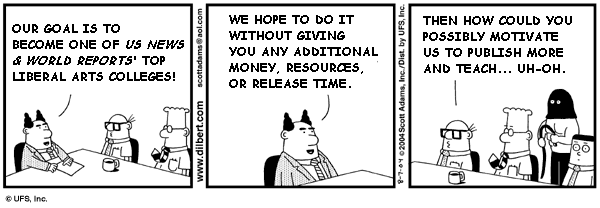
Saturday, November 25, 2006
History Takes Over at the Movies
I went to see Stranger than Fiction* today (which has nothing to do with history) and was surprised that every single preview featured an upcoming film based on a true story or set in a historical time period.
First was We Are Marshall. This film follows the rebuilding of the Marshall football team after most of its players and coaching staff were killed in a plane crash.
Second was a preview for Mel Gibson's Apocalypto, which is about the decline of the Mayan civilization.
Then they showed a preview of The Pursuit of Happyness. This movie is based on the true story of Christopher Gardener, a successful stock broker who worked his way up from the bottom of the industry while raising his toddler son and being homeless for a time.
They also showed a preview for Night at the Museum. This one is a bit of a stretch, but it is about the exhibits at the Smithsonian's Museum of Natural History coming alive at night. Apparently, Robin Williams has a fairly big role in the film as Theodore Roosevelt.
Add these to the currently playing Bobby (about the assassination of Robert Kennedy) and The History Boys and it seems like Hollywood is in love with history.
Why is this important?
I think it serves as a great reminder that what historians do - tell stories - explain why people's lives are significant - contextualize the past so that it makes sense to present - is interesting to a number of people. Film makers wouldn't produce these pictures if people didn't care about them. A lot more people are drawn to history than we see in our classes or who buy our books. I think historians can take some comfort from this - or be really depressed about it.
(* In Stranger Than Fiction a English professor plays a major role in the film. This professor says at one point in the film that he is teaching 5 classes and directing 2 graduate theses. What I want to know is what college with Ph.D. students has professors who teaching more than a 2/2 load? I mean come on!)
First was We Are Marshall. This film follows the rebuilding of the Marshall football team after most of its players and coaching staff were killed in a plane crash.
Second was a preview for Mel Gibson's Apocalypto, which is about the decline of the Mayan civilization.
Then they showed a preview of The Pursuit of Happyness. This movie is based on the true story of Christopher Gardener, a successful stock broker who worked his way up from the bottom of the industry while raising his toddler son and being homeless for a time.
They also showed a preview for Night at the Museum. This one is a bit of a stretch, but it is about the exhibits at the Smithsonian's Museum of Natural History coming alive at night. Apparently, Robin Williams has a fairly big role in the film as Theodore Roosevelt.
Add these to the currently playing Bobby (about the assassination of Robert Kennedy) and The History Boys and it seems like Hollywood is in love with history.
Why is this important?
I think it serves as a great reminder that what historians do - tell stories - explain why people's lives are significant - contextualize the past so that it makes sense to present - is interesting to a number of people. Film makers wouldn't produce these pictures if people didn't care about them. A lot more people are drawn to history than we see in our classes or who buy our books. I think historians can take some comfort from this - or be really depressed about it.
(* In Stranger Than Fiction a English professor plays a major role in the film. This professor says at one point in the film that he is teaching 5 classes and directing 2 graduate theses. What I want to know is what college with Ph.D. students has professors who teaching more than a 2/2 load? I mean come on!)
Friday, November 24, 2006
Cold War Toys
I found these photos while surfing around the internet. I never really thought about the relationship between children's play things and cultural attitudes of the time period they were produced until I saw them. Of course like movies or TV shows or other popular cultural artifacts, it is not surprising that the concerns and worries of society make their way into what gets marketed to the youngest and most impressionable.

Given this understanding, what makes more sense during the Cold War years - as public fears about the development of atomic bombs sweeps the nation - than to sell kids Chutes Away a airplane toy that allows children to drop yellow plastic bombs into targets. What a great toy for Santa to leave under the Christmas Tree. The entire family can come back from Christmas mass and pretend to destroy the world. (As I reexamine the box - maybe the kids are dropping parachutes and not bombs. Although it doesn't make any sense to drop parachutes to people on the ground - what are they going to do with them? Maybe this is a Berlin Airlift type of game.)
Of course, should your family fail to annihilate communism through atomic bombing and the red hordes infiltrate the U.S. government, then you might need to purge American society of undesirable socialist influences. Apparently, Milton Bradley did not think that HUAC committee action figures would be a big seller, so instead kids in the fifties were provided with an example of how the French got rid of their trouble makers.
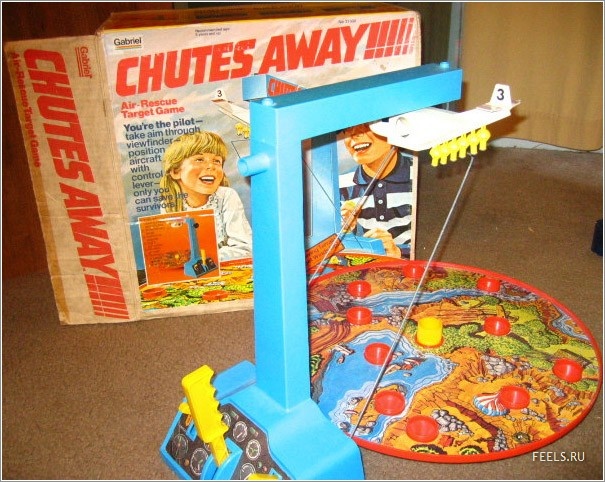
Given this understanding, what makes more sense during the Cold War years - as public fears about the development of atomic bombs sweeps the nation - than to sell kids Chutes Away a airplane toy that allows children to drop yellow plastic bombs into targets. What a great toy for Santa to leave under the Christmas Tree. The entire family can come back from Christmas mass and pretend to destroy the world. (As I reexamine the box - maybe the kids are dropping parachutes and not bombs. Although it doesn't make any sense to drop parachutes to people on the ground - what are they going to do with them? Maybe this is a Berlin Airlift type of game.)
Of course, should your family fail to annihilate communism through atomic bombing and the red hordes infiltrate the U.S. government, then you might need to purge American society of undesirable socialist influences. Apparently, Milton Bradley did not think that HUAC committee action figures would be a big seller, so instead kids in the fifties were provided with an example of how the French got rid of their trouble makers.
 I wonder who is in charge of developing inappropriate historical toys for children? In the politically correct times we live in, should I worry about my local ToysRUs selling a Tar and Feather the Loyalists Goo Machine or a Rosenberg Espionage Easy-Bake Electric Chair. At least someone else thinks it is a real threat - since on YouTube.com there is a spoof commercial for Jihad Joe.
All joking aside, I do think "Cold War Era Children's Toys" is a cultural history project just waiting to be embraced.
Wednesday, November 22, 2006
Tuesday, November 21, 2006
Big Increases In the Starting Salaries of History Majors
Never thought I'd see history listed as one of majors that experienced big increases in average starting salaries -- but according to CNNMoney.com that is exactly what happened last year. The starting salary for new history majors rose by 4.2% the same as the percentage increase for business administration/management majors.
I can just picture the line outside of my door on the Monday after Thanksgiving as everyone wants to now sign up to be a history major. I just won't mention that fact that although history majors and business administration majors saw the same percentage increases in starting salaries that the average salary for history majors (33,071) is a little over $8,000 less than the average salary for those in business (41,155).
I can just picture the line outside of my door on the Monday after Thanksgiving as everyone wants to now sign up to be a history major. I just won't mention that fact that although history majors and business administration majors saw the same percentage increases in starting salaries that the average salary for history majors (33,071) is a little over $8,000 less than the average salary for those in business (41,155).
Wednesday, November 15, 2006
Historian in the News
While some of my students have probably compared sitting through my lecture on the creation of the Second Party System to being in hell, I have never actually warned any of my students that they were headed for the nether regions if they didn't accept J.C. as their personal savior.
There is at least one historian in New Jersey, however, who apparently spends his time "lecturing students more about Heaven and Hell than the colonies and Constitution."
He got caught because one of his students taped his class lectures.
I have nothing more to say about this New Jersey historian, except that this makes me even more wary of podcasting. Who knows how what I might consider to be just a cute little analogy (like comparing the Bay of Pigs Invasion to a naked man getting beaten to death at a party) might get taken out of context if heard on a podcast.
There is at least one historian in New Jersey, however, who apparently spends his time "lecturing students more about Heaven and Hell than the colonies and Constitution."
He got caught because one of his students taped his class lectures.
I have nothing more to say about this New Jersey historian, except that this makes me even more wary of podcasting. Who knows how what I might consider to be just a cute little analogy (like comparing the Bay of Pigs Invasion to a naked man getting beaten to death at a party) might get taken out of context if heard on a podcast.
Saturday, November 11, 2006
Grading Exams
I am usually pretty laid-back when it comes to grammar while grading exams. I tell my students that as long as they write sentences that make sense and put them in something that looks like a paragraph, I'll be satisfied. I never bother with misspellings or fragments during timed exams because I'd rather they concentrate on demonstrating that they know and understand the material.
Usually, this works out fine and I have no trouble recognizing FDR, WWI, or even the symbol for 'women'. However, I do think New Zealand is taking things a bit too far. The year New Zealand students are going to allowed to use text-speak to answer questions on the national exam. So instead of spelling out complete words they can use U for you, txt for text, and D-bag for Douche-Bag (see this post if you don't think a student would never use that in an exam).
I think this is going a bit too far. Not because I think that text-speak is going to bring down civilization as we know it, but because how the heck are the graders/professors going to know for certain what the student is trying to convey? Does everyone but me recognize these terms? Is there even a standard interpretation of them?
I propose we all stand up to the text messengers and demand that our students continue to use vowels appropriately and if you don't like it -- FU.
Usually, this works out fine and I have no trouble recognizing FDR, WWI, or even the symbol for 'women'. However, I do think New Zealand is taking things a bit too far. The year New Zealand students are going to allowed to use text-speak to answer questions on the national exam. So instead of spelling out complete words they can use U for you, txt for text, and D-bag for Douche-Bag (see this post if you don't think a student would never use that in an exam).
I think this is going a bit too far. Not because I think that text-speak is going to bring down civilization as we know it, but because how the heck are the graders/professors going to know for certain what the student is trying to convey? Does everyone but me recognize these terms? Is there even a standard interpretation of them?
I propose we all stand up to the text messengers and demand that our students continue to use vowels appropriately and if you don't like it -- FU.
Thursday, November 9, 2006
Academic Leadership in the Department of Defense
While I realize it is stretching it a bit to refer to Secretary of Defense nominee Robert Gates as an 'academic', he does qualify in some ways since he is as a history Ph.D. and the president of a university. After a little checking, I discovered that previous Secretaries of Defense fit the mold of an academic even better than Gates.
First was James Schlesinger, a Ph.D. in economics who taught at the University of Virginia, before serving as Secretary of Defense under Nixon from 1973-1975.
Second, Harold Brown, a Physics Ph.D., who had only a short teaching stint, but eventually ended up as Jimmy Carter's Secretary of Defense from 1977-1981.
Third was Les Aspin, a Ph.D. in economics (and a BA in history), who taught for several years at Marquette. He was Clinton's Secretary of Defense from 1993-1994.
William Perry, Bill Clinton's Secretary of Defense from 1994-1997, had a Ph.D. in math. However, as far as I could tell, he never had an academic appointment.
First was James Schlesinger, a Ph.D. in economics who taught at the University of Virginia, before serving as Secretary of Defense under Nixon from 1973-1975.
Second, Harold Brown, a Physics Ph.D., who had only a short teaching stint, but eventually ended up as Jimmy Carter's Secretary of Defense from 1977-1981.
Third was Les Aspin, a Ph.D. in economics (and a BA in history), who taught for several years at Marquette. He was Clinton's Secretary of Defense from 1993-1994.
William Perry, Bill Clinton's Secretary of Defense from 1994-1997, had a Ph.D. in math. However, as far as I could tell, he never had an academic appointment.
A Historian for Secretary of Defense
I was pretty shocked by the news that Donald Rumsfeld is resigning as Secretary of Defense, but that doesn't come close to matching my shock that his replacement could be current Texas A&M president and historian Robert M. Gates.
Gates received a master's in history from Indiana University in 1966 and his Ph.D. in Russian and Soviet history from Georgetown University in 1974. These are two high ranking history programs so I couldn't help but be a little impressed at these credentials.
His dissertation - SOVIET SINOLOGY: AN UNTAPPED SOURCE FOR KREMLIN VIEWS AND DISPUTES RELATING TO CONTEMPORARY EVENTS IN CHINA - is a weighty 306 pages long.
Although it doesn't look like he ever spent any real time in the classroom behind the lectern, I wonder if he will be the first 'academic' to serve as Secretary of Defense? There have been lots of academics who have held the Secretary of State job, but I can't think of any who have served in this capacity [although I'm going to go research it ASAP]. It should be interesting to see how someone like Gates can combine his practical experience from the CIA and other government positions, with his historical understanding of how the world operates.
Looks like I'll have to add another name to my list of famous historians if Gates is confirmed.
Gates received a master's in history from Indiana University in 1966 and his Ph.D. in Russian and Soviet history from Georgetown University in 1974. These are two high ranking history programs so I couldn't help but be a little impressed at these credentials.
His dissertation - SOVIET SINOLOGY: AN UNTAPPED SOURCE FOR KREMLIN VIEWS AND DISPUTES RELATING TO CONTEMPORARY EVENTS IN CHINA - is a weighty 306 pages long.
Although it doesn't look like he ever spent any real time in the classroom behind the lectern, I wonder if he will be the first 'academic' to serve as Secretary of Defense? There have been lots of academics who have held the Secretary of State job, but I can't think of any who have served in this capacity [although I'm going to go research it ASAP]. It should be interesting to see how someone like Gates can combine his practical experience from the CIA and other government positions, with his historical understanding of how the world operates.
Looks like I'll have to add another name to my list of famous historians if Gates is confirmed.
Saturday, November 4, 2006
Presidential Celebrity Doppelgangers
Okay... this is what happens when you have too much time on your hands. I ran George Washington's picture through a face recognition program that claims to match pictures up to their celebrity look-alikes. The results were surprising. Apparently the celebrity that most looks like Washington is Takeshi Kitano - the 5' 5" Japanese actor and director. Who would have guessed?

Of course, once I got started down this path I couldn't just stop with Washington. Therefore, I loaded up a picture of Abraham Lincoln into the face recognition program and what do you know - out popped Jean-Michel Jarre - the French composer and music producer. Yuck.

I decided to give it one more shot and put in a picture of Warren G. Harding - reputedly one of America's best looking presidents - and imagine my surprise to discover that if Yitzhak Rabin and Madonna had ever had a child, he would look a lot like Harding.
I would also like to know what Bill Clinton and John Ashcroft would think about being 68% celebrity matches for Harding.

Of course, once I got started down this path I couldn't just stop with Washington. Therefore, I loaded up a picture of Abraham Lincoln into the face recognition program and what do you know - out popped Jean-Michel Jarre - the French composer and music producer. Yuck.
I decided to give it one more shot and put in a picture of Warren G. Harding - reputedly one of America's best looking presidents - and imagine my surprise to discover that if Yitzhak Rabin and Madonna had ever had a child, he would look a lot like Harding.
I would also like to know what Bill Clinton and John Ashcroft would think about being 68% celebrity matches for Harding.
Thursday, November 2, 2006
Happy Birthday Warren!
It is Warren G. Harding's birthday today. He was born Nov. 2, 1865 and died while in office in 1923. Although the country deeply mourned Harding, soon after his death tales of corruption in his administration began making newspaper headlines. Ever since, historians have ranked Harding as the worst president in history.
Dr. History, however, has a prescription to get Harding out of the historical basement. It is time for a bit of revisionism.
Let us take the main charges against Harding and see if we can spin them:
1. Unable to stand up to his corrupt friends
Dr. History, however, has a prescription to get Harding out of the historical basement. It is time for a bit of revisionism.
Let us take the main charges against Harding and see if we can spin them:
1. Unable to stand up to his corrupt friends
- Loyal man, who remember those who got him to the top.
- Not an intellectual snob
- Able to delegate authority to experts
- Valued private enterprise
- Open to new experiences
- Far-sighted
Now how can any man you can describe as far-sighted, open and loyal ever be voted America's worst president?
Saturday, October 28, 2006
Hot Library Smut
OMG... You'll never look at the stacks the same way again.
Am I sick to be a little turned on by this?
Am I sick to be a little turned on by this?
History Graduate Students Less Likely to Cheat
I just read a news story that suggested that humanities and social science graduate students were less likely to cheat than students in other degree programs. The numbers of each discipline that admitted to cheating are as follows:
39% humanities and social science graduate students
43% arts graduate students
49% medical and other health-care graduate students
50% physical sciences graduate students
54% engineering graduate students, and
56% business graduate students
Although I am surprised by how high these numbers are (even for the humanities students), I can't help but wonder why humanities graduate students are less likely to cheat than MBA students. I really doubt that people with higher ethical or moral values are drawn into the humanities than into business.
I suspect that there might be three other reasons for these results.
1. It is easier to get into a MBA program than a humanities graduate program. While it is not ONLY weak students who cheat, in my experience it is often those students who are struggling or feel like they can't make it without cheating who give into the temptation. So perhaps because MBA students are weaker in general than humanities graduate students, they are more likely to feel the pressure to cheat to get through with their programs.
2. Perhaps the type of assignments given to humanities students makes it less likely that they will cheat. I mean how are you going to cheat in a reading seminar? Ever try to participate in discussion having only read the book reviews about a book and not the book? It feels a little like walking into seminar wearing a swimming suit and hoping that no else in the room notices. I suppose plagiarizing on a paper is more likely, but even then why bother plagiarizing a few paragraphs of a 25 page paper. You might as well just write the entire thing. Maybe the typical assignments given to MBA students are easier to cheat on.
3. Cheating breeds cheating. If there is a culture in place among students that hold that it is okay to cheat, it is easier for students coming into that environment to cheat as well. I had dinner at the AHA a couple of years back with some of my friends who had just graduated out of our Ph.D. program and they could recall in disgusted detail a fellow graduate student who was caught cheating. There was definitely an attitude among these students that it was unacceptable to cheat and they wanted the professors to take a hard line on any caught cheating. Anyone coming into that program would soon discover what the acceptable behaviors were in regards to academic integrity.
39% humanities and social science graduate students
43% arts graduate students
49% medical and other health-care graduate students
50% physical sciences graduate students
54% engineering graduate students, and
56% business graduate students
Although I am surprised by how high these numbers are (even for the humanities students), I can't help but wonder why humanities graduate students are less likely to cheat than MBA students. I really doubt that people with higher ethical or moral values are drawn into the humanities than into business.
I suspect that there might be three other reasons for these results.
1. It is easier to get into a MBA program than a humanities graduate program. While it is not ONLY weak students who cheat, in my experience it is often those students who are struggling or feel like they can't make it without cheating who give into the temptation. So perhaps because MBA students are weaker in general than humanities graduate students, they are more likely to feel the pressure to cheat to get through with their programs.
2. Perhaps the type of assignments given to humanities students makes it less likely that they will cheat. I mean how are you going to cheat in a reading seminar? Ever try to participate in discussion having only read the book reviews about a book and not the book? It feels a little like walking into seminar wearing a swimming suit and hoping that no else in the room notices. I suppose plagiarizing on a paper is more likely, but even then why bother plagiarizing a few paragraphs of a 25 page paper. You might as well just write the entire thing. Maybe the typical assignments given to MBA students are easier to cheat on.
3. Cheating breeds cheating. If there is a culture in place among students that hold that it is okay to cheat, it is easier for students coming into that environment to cheat as well. I had dinner at the AHA a couple of years back with some of my friends who had just graduated out of our Ph.D. program and they could recall in disgusted detail a fellow graduate student who was caught cheating. There was definitely an attitude among these students that it was unacceptable to cheat and they wanted the professors to take a hard line on any caught cheating. Anyone coming into that program would soon discover what the acceptable behaviors were in regards to academic integrity.
Friday, October 27, 2006
The Phrase I Never Want to Hear Again
I hope never to hear or read again the phrase: "History will judge." It seems like every time I turn on the t.v. or listen to news on the radio there is someone else spouting off about the judgment of history. Listen people: HISTORY DOES NOT JUDGE - HISTORIANS DO!
Why do I care?
I care because by suggesting that history is the judge, rather than historians, you are undermining the place of the historian in society. I have 65 undergraduate history majors running around campus thinking that they aren't as important to society as the majors in business or chemistry or what have you because those other majors that "do" something - they might one day be influential and change the direction of society.
Well, historians do something too. We can put the actions of past political leaders in context, we can tease out the short- and long-term consequences of those actions, and we can JUDGE the significance and rightness of those actions. Moreover, the view of historians on events like the Vietnam War or Social Security or the Civil Rights Movement can impact policy makers. So how about we start giving historians some credit for what they do.
Why do I care?
I care because by suggesting that history is the judge, rather than historians, you are undermining the place of the historian in society. I have 65 undergraduate history majors running around campus thinking that they aren't as important to society as the majors in business or chemistry or what have you because those other majors that "do" something - they might one day be influential and change the direction of society.
Well, historians do something too. We can put the actions of past political leaders in context, we can tease out the short- and long-term consequences of those actions, and we can JUDGE the significance and rightness of those actions. Moreover, the view of historians on events like the Vietnam War or Social Security or the Civil Rights Movement can impact policy makers. So how about we start giving historians some credit for what they do.
Thursday, October 26, 2006
Nazi Home Movies
Home movies made by Nazi officers during the German invasion of Russia have been found in a church in Devon. You can watch the film here.
I show my 1877-present survey students part of the documentary "The Democrat and the Dictator" which compares and contrasts the childhoods and political styles of Roosevelt and Hitler. Students continually come away from that film with a bit more understanding about how Hitler could have been found appeal by German civilians - especially given his rhetoric, speaking style, and the mass response he got from crowds. It would be interesting to compare that public view portrayed by the Nazi's - fiery words and eerie symbolism - to the private and personal view seen in this film.
I show my 1877-present survey students part of the documentary "The Democrat and the Dictator" which compares and contrasts the childhoods and political styles of Roosevelt and Hitler. Students continually come away from that film with a bit more understanding about how Hitler could have been found appeal by German civilians - especially given his rhetoric, speaking style, and the mass response he got from crowds. It would be interesting to compare that public view portrayed by the Nazi's - fiery words and eerie symbolism - to the private and personal view seen in this film.
Wednesday, October 25, 2006
It is that time of year again
Well, I've hit the point in the semester where I am so over my head in keeping up with my classes and getting my grading done that I bribe my students with candy. Today they get their choice of saltwater taffy or those Halloween peanutbutter chews.
Update: According to my students - Halloween peanutbutter chews are the worst Halloween candy ever invented [these are things wrapped in oranage or black paper].
Update: According to my students - Halloween peanutbutter chews are the worst Halloween candy ever invented [these are things wrapped in oranage or black paper].
Monday, October 23, 2006
The All-Powerful Historian
I just love it when politicians try and predict how historians are going to view events in the future. President Bush's recent comment "that this traumatic period in Iraq will be seen as 'just a comma' in the history books" suggests that when all is said and done and historians look back on the beginning of the twenty-first century the current violence in Iraq won't merit much attention by those in my profession.
He might be right. Twenty years from now, when I am lecturing in my U.S. survey course and complaining about how I never get passed the presidency of the George W. Bush, I might not spend much time discussing the war in Iraq or the consequences of it. On the other hand, if Sept. 11 is the 21st Century's Pearl Harbor or the War on Terror becomes the next generation's World World III - I might devote a full week of lectures to the War in Iraq - maybe the class will do a book assignment on some American soldier's experiences at Guantanamo Bay - perhaps they will watch part of a documentary on the origins and development of neo-conservative foreign policy.
My point is that it is pointless to speculate about how historians will view some current action in the future. We won't know the full significance or importance of most policies or events until we know the complete consequences of those events. Moreover, how those consequences are viewed 20 years from now, is not necessarily the same way they'll be viewed 40 years from now as new evidence comes to light and society's concerns change and develop over time.
I realize this view of history is probably not very comforting to those who are seeking to leave an important legacy and hope to be remembered fondly in the future. However, it should be heartening to all my fellow historians. Because ultimately what it means is that we get to decide who was great and who was not. We get to interpret what events are significant and what is just a 'comma'. Who needs money or power or influence today - when the historian has the power to determine what the world of tomorrow remembers about the wealthy, influential, powerful leaders of today.
He might be right. Twenty years from now, when I am lecturing in my U.S. survey course and complaining about how I never get passed the presidency of the George W. Bush, I might not spend much time discussing the war in Iraq or the consequences of it. On the other hand, if Sept. 11 is the 21st Century's Pearl Harbor or the War on Terror becomes the next generation's World World III - I might devote a full week of lectures to the War in Iraq - maybe the class will do a book assignment on some American soldier's experiences at Guantanamo Bay - perhaps they will watch part of a documentary on the origins and development of neo-conservative foreign policy.
My point is that it is pointless to speculate about how historians will view some current action in the future. We won't know the full significance or importance of most policies or events until we know the complete consequences of those events. Moreover, how those consequences are viewed 20 years from now, is not necessarily the same way they'll be viewed 40 years from now as new evidence comes to light and society's concerns change and develop over time.
I realize this view of history is probably not very comforting to those who are seeking to leave an important legacy and hope to be remembered fondly in the future. However, it should be heartening to all my fellow historians. Because ultimately what it means is that we get to decide who was great and who was not. We get to interpret what events are significant and what is just a 'comma'. Who needs money or power or influence today - when the historian has the power to determine what the world of tomorrow remembers about the wealthy, influential, powerful leaders of today.
Thursday, October 19, 2006
Women - Know Your Limits
This is a video spoof on public improvement films in the 1940s-1950s. One of the best lines: Over-education [of women] leads to ugliness, premature aging, and beard growth.
If you think this is over the top, check out some of the REAL videos from the Prelinger Archives. Here are a couple of classic gems about gender-roles you don't want to miss -
Are you Popular? (1947)
Jealously (1954)
Why Study Home Economics? (1955)
If you think this is over the top, check out some of the REAL videos from the Prelinger Archives. Here are a couple of classic gems about gender-roles you don't want to miss -
Are you Popular? (1947)
Jealously (1954)
Why Study Home Economics? (1955)
Wednesday, October 18, 2006
Zachary Taylor Joke
Got this from the Daily Show:
Why did Zachary Taylor arrive at his 1848 nominating convention wearing a Marie Antoinette headpiece?
He heard he was nominated by the "Whig" party!
I am definitely using this joke next time I teach the first half of American survey.
Why did Zachary Taylor arrive at his 1848 nominating convention wearing a Marie Antoinette headpiece?
He heard he was nominated by the "Whig" party!
I am definitely using this joke next time I teach the first half of American survey.
The Best Stuff
I ran across a website that allows you to vote on what you think is the best stuff in the world. I was majorly disappointed to find out that when voting for the best subject: history came in after English and art. On the upside though - people liked history better than philosphy, physics, and math.
Other best history related matters:
Best woman in history - Mary Seacole
Best date to know in history - 1066
Best history to study: Ancient Rome
Best person in history: Julius Ceasar
I can't wait until the best historian category gets added. William A Williams, perhaps?
Other best history related matters:
Best woman in history - Mary Seacole
Best date to know in history - 1066
Best history to study: Ancient Rome
Best person in history: Julius Ceasar
I can't wait until the best historian category gets added. William A Williams, perhaps?
Tuesday, October 17, 2006
History Songs
I started this one night, but got distracted. Nevertheless here are some history songs - cuz you aren't a real history nerd until you got a favorite history song.
My 2 favorite history songs don't actually mention 'history' in the lyrics. Instead the lyrics mention historical events. 1. Band - Night They Drove Ol' Dixie Down (Virgil Caine is the name - and I served on the Danville train - 'Til Stoneman's cavalry came - and tore up the tracks again. - In the winter of '65 - We were hungry - just barely alive. - By May the tenth - Richmond had fell - it's a time I remember, oh so well); 2. Alabama - Song of the South (Well somebody told us wall street fell - But we were so poor that we couldn't tell. - Cotton was short and the weeds were tall - But Mr. Roosevelts a gonna save us all.)
Here are a few songs that actually mention history in the lyrics.
School Days - Chuck Berry
"Up in the morning and off to school - the teacher is teaching the golden rule. - American history and practical math - you study them hard, hoping to pass - working your fingers right down to the bone - the guy behind you won´t leave you alone."
History - Michael Jackson
"Every day create your history - Every path you take you're leaving your legacy - Every soldier dies in history - Every legend tells of conquest and liberty"
History - The Verve
"I'm thinking about history - And I'm living for history - And I think you know about me - Cause I am"
My 2 favorite history songs don't actually mention 'history' in the lyrics. Instead the lyrics mention historical events. 1. Band - Night They Drove Ol' Dixie Down (Virgil Caine is the name - and I served on the Danville train - 'Til Stoneman's cavalry came - and tore up the tracks again. - In the winter of '65 - We were hungry - just barely alive. - By May the tenth - Richmond had fell - it's a time I remember, oh so well); 2. Alabama - Song of the South (Well somebody told us wall street fell - But we were so poor that we couldn't tell. - Cotton was short and the weeds were tall - But Mr. Roosevelts a gonna save us all.)
Here are a few songs that actually mention history in the lyrics.
School Days - Chuck Berry
"Up in the morning and off to school - the teacher is teaching the golden rule. - American history and practical math - you study them hard, hoping to pass - working your fingers right down to the bone - the guy behind you won´t leave you alone."
History - Michael Jackson
"Every day create your history - Every path you take you're leaving your legacy - Every soldier dies in history - Every legend tells of conquest and liberty"
History - The Verve
"I'm thinking about history - And I'm living for history - And I think you know about me - Cause I am"
Monday, October 2, 2006
The Pains of Grading
I try to be a bit informal with my students and I never get too uptight about exactly how they choose to discuss the material on their exams. I figure if they have the information correct, basically understand the big concepts, and are able to support their points - that I can over look a little informal language.
But, I have just read an exam that makes me want to sit down and give my entire upper-division level American Foreign Policy class a lecture about appropriate word choice for exams. The offending sentence reads: "Our exclusion from the League of Armed Neutrality demonstrated that Europe is subject to douche-baggery."
First of all, I think douche bag can only be used as a noun and second -- when the heck did such terms become proper language for exams? I can just roll my eyes at how later in the essay the student refers to the French as "sorry Frogs," but surely at some point I have to address this lack of judgment.
I think one reason I am offended about this is that douche bag really is open to interpretation about what the heck it means. Maybe, instead of broaching this topic to the class in terms of 'inappropriate language' I can approach from the perspective of 'imprecise' language. Sounds more scholarly and less prissy that way.
But, I have just read an exam that makes me want to sit down and give my entire upper-division level American Foreign Policy class a lecture about appropriate word choice for exams. The offending sentence reads: "Our exclusion from the League of Armed Neutrality demonstrated that Europe is subject to douche-baggery."
First of all, I think douche bag can only be used as a noun and second -- when the heck did such terms become proper language for exams? I can just roll my eyes at how later in the essay the student refers to the French as "sorry Frogs," but surely at some point I have to address this lack of judgment.
I think one reason I am offended about this is that douche bag really is open to interpretation about what the heck it means. Maybe, instead of broaching this topic to the class in terms of 'inappropriate language' I can approach from the perspective of 'imprecise' language. Sounds more scholarly and less prissy that way.
Monday, September 25, 2006
4 out of 5 of the Wealthiest Men in the U.S. are College Drop-Outs
MSN.com has a story today about how it now takes at least $1 billion to make it on Forbes' annual list of the 400 richest Americans. What I found most interesting, however, were the biographies the story provided on the top 11 richest people. Out of the 11, two haveBachelors of Arts/Science degrees, one has a Master of Science, one has a doctorate in law, 3 have no educational information listed, and 5 are college drop-outs.
This type of information makes me wonder whether they dropped out because they came up with some great idea and felt like college was getting in the way of that idea (Bill Gates) or whether they failed out and then later got their acts together.
I wonder if I could convince the students who fail my mid-term that I am really doing them a favor by increasing their chances of one day becoming a billionaire?
This type of information makes me wonder whether they dropped out because they came up with some great idea and felt like college was getting in the way of that idea (Bill Gates) or whether they failed out and then later got their acts together.
I wonder if I could convince the students who fail my mid-term that I am really doing them a favor by increasing their chances of one day becoming a billionaire?
Friday, September 22, 2006
I'll show you my QEP, if you'll show me yours...
A QEP (Quality Enhancement Plan), for the blissfully uninitiated, is a required part of the reaccreditation process for those schools who are part of the Southern Association of Colleges and Schools (SACS). To earn reaccreditation, colleges need to develop a program or focused course of action - preferably one that is tied to their institution's mission statement - that will enhance student learning. Some school's QEP's include - focusing more on student writing, helping students succeed in a global society, increasing student engagement in their learning, and improving faculty-student interaction.
I personally find the entire process irritating and would be overjoyed to leave the entire thing in the hands of the administration - only they would probably come up with a QEP that was so time consuming and paperwork driven that I'd be putting in 80 hours a week at the office instead of 60.
Nevertheless, I've quickly discovered that what most of my colleagues believe would really improve student learning is finding someway to make their discipline more important to the rest of the campus community. Economics Across the Curriculum, Biography Across the Curriculum, Biology Across the Curriculum - the answer to all our student's intellectual failings! I suppose that it shouldn't be surprising that most people believe that their discipline is essential to a well-rounded and informed student. But please show some restraint and be able to provide a justification that goes beyond that the student's in your upper division level classes really seem to benefit from similar endeavors.
Also, keep an open mind about my History Across the Curriculum QEP proposal.
I personally find the entire process irritating and would be overjoyed to leave the entire thing in the hands of the administration - only they would probably come up with a QEP that was so time consuming and paperwork driven that I'd be putting in 80 hours a week at the office instead of 60.
Nevertheless, I've quickly discovered that what most of my colleagues believe would really improve student learning is finding someway to make their discipline more important to the rest of the campus community. Economics Across the Curriculum, Biography Across the Curriculum, Biology Across the Curriculum - the answer to all our student's intellectual failings! I suppose that it shouldn't be surprising that most people believe that their discipline is essential to a well-rounded and informed student. But please show some restraint and be able to provide a justification that goes beyond that the student's in your upper division level classes really seem to benefit from similar endeavors.
Also, keep an open mind about my History Across the Curriculum QEP proposal.
Thursday, September 21, 2006
www.picture-history.com
This is a very cool site. They have images from the last 150 years and arranged by collection. Some of the collections include:
- African Americans
- Civil War
- Europe
- Indians
- United States in the 1930s and 1940s
- Old West
What I like most about this site, however, is the quality of the images. They are just amazing. I'm already trying to find some to use later on this semester with my lectures.
Thursday, September 14, 2006
FSU to Phase Out College of Arts and Sciences
Finally, FSU gets its priorities right. First, the College of Arts and Sciences will be cut and then the rest of the academic program is getting eliminated. Read all about it.
Thursday, August 31, 2006
You know it's good when...
I am teaching an undergraduate reading seminar this semester and got a thrill Monday evening while reading one of the assignments for the class. It was the type of article that actually gave me an adrenalin rush as I thought to myself - 'Damn, this is brilliant.' I even went into class the next day and told my students about how a specific part of the article had 'Knocked me out of my chair.' A few of the nodded... they had apparently gotten the same rush.
Now that I am thinking back on it, however, I can't decide how geeky it is get such a physical reaction from reading a piece of non-fiction. Of course, geeky or not the real sad part is that it happens so rarely. I remember only a few other times when I've read something so illuminating that it actually made me sit up straighter and feel more alive.
Don't get me wrong, I've read lots of history articles that I agreed with, found interesting, and thought were well written. But this is something different.... maybe more primal. This is the feeling that drew me into the discipline (although at the time I was getting that feeling from lectures by my undergrad professors). And it is definitely a feeling that keeps me motivated to do additional reading and research. I just wish it wasn't so rare.
Now that I am thinking back on it, however, I can't decide how geeky it is get such a physical reaction from reading a piece of non-fiction. Of course, geeky or not the real sad part is that it happens so rarely. I remember only a few other times when I've read something so illuminating that it actually made me sit up straighter and feel more alive.
Don't get me wrong, I've read lots of history articles that I agreed with, found interesting, and thought were well written. But this is something different.... maybe more primal. This is the feeling that drew me into the discipline (although at the time I was getting that feeling from lectures by my undergrad professors). And it is definitely a feeling that keeps me motivated to do additional reading and research. I just wish it wasn't so rare.
Monday, August 21, 2006
Nightmare on University Street
It is now 14.5 hours and counting until my first Tuesday class of the semester. I still have to finish the syllabus, put some handouts online, and decide on exactly what the % breakdown on the assignments will be. I'm sure I'll end up with a massive headache before the night is over.
This wouldn't be so bad except that I am close to living in reality my recurring pre-school year nightmare. At least once or twice before each semester begins, I have a dream where it is the first day of the semester and I suddenly remember that I have a class starting in just minutes that I haven't written a syllabus for. I end up running around in the dream all stressed out trying to hurry and finish the syllabus while trying to keep the students in the classroom without me in it. Usually I try to accomplish this by making some random student who comes to my office asking where the heck I am to go into the classroom and tell the rest of the students that I'm on my way. I really hate that dream, because the anxiety it produces makes me feel almost as bad as if I REALLY forgot about a class.
I have some colleagues who have recurring nightmares about it being finals week when they suddenly discover they had a class all semester that they never attended. I've heard of other professors who dream about showing up for class and having forgotten to put on their clothes.
Best I can tell, all these dreams seem to indicate most academics have a deep fear that they are going to forget something important about their discipline and that someone will discover that they are frauds. They worry that somehow they unfairly convinced a university to give them a Ph.D. in history even though they don't really understand post-structuralism and never learned what William A. Williams and the Wisconsin School were saying about American foreign policy. I don't know who to blame for this fear - probably graduate school seminars - but I wonder if computer programers or lawyers face this same type of worry?
I plan on taking a couple of Excederin PM before bed tonight. Hopefully that will block out the nightmares. I wish everyone else sweet dreams.
This wouldn't be so bad except that I am close to living in reality my recurring pre-school year nightmare. At least once or twice before each semester begins, I have a dream where it is the first day of the semester and I suddenly remember that I have a class starting in just minutes that I haven't written a syllabus for. I end up running around in the dream all stressed out trying to hurry and finish the syllabus while trying to keep the students in the classroom without me in it. Usually I try to accomplish this by making some random student who comes to my office asking where the heck I am to go into the classroom and tell the rest of the students that I'm on my way. I really hate that dream, because the anxiety it produces makes me feel almost as bad as if I REALLY forgot about a class.
I have some colleagues who have recurring nightmares about it being finals week when they suddenly discover they had a class all semester that they never attended. I've heard of other professors who dream about showing up for class and having forgotten to put on their clothes.
Best I can tell, all these dreams seem to indicate most academics have a deep fear that they are going to forget something important about their discipline and that someone will discover that they are frauds. They worry that somehow they unfairly convinced a university to give them a Ph.D. in history even though they don't really understand post-structuralism and never learned what William A. Williams and the Wisconsin School were saying about American foreign policy. I don't know who to blame for this fear - probably graduate school seminars - but I wonder if computer programers or lawyers face this same type of worry?
I plan on taking a couple of Excederin PM before bed tonight. Hopefully that will block out the nightmares. I wish everyone else sweet dreams.
Sunday, August 20, 2006
History Laughs
Classes start tomorrow - I still have a syllabus to figure out for Tuesday. So obviously what I need to be doing is looking for historical jokes. Here are some of the best I've found:
1. I went to a restaurant that serves 'breakfast at any time.' So I ordered French toast during the Renaissance.
2. Jimmy Kimmel said: Historians just found a document that showed a list of liquor George Washington wanted for his New York headquarters, including a key of brandy, a box of claret, a box of fortified wine, a basket of cordials, and two kinds of cheese. So not only was George Washington the father of our coutnry, he also invented the mini-bar.
3. Why were the early days of history called the dark ages? - Because there were so many knights!
4. An angel appears at a faculty meeting and tells the history teacher that in return for his unselfish and exemplary behavior, the Lord will reward him with his choice of infinite wealth, wisdom, or beauty. Without hesitating, the history teacher selects infinite wisdom.
"Done!" says the angel, and disappears in a cloud of smoke and a bolt of lightning. Now, all heads turn toward the history teacher, who sits surrounded by a faint halo of light.
One of his colleagues whispers, "Say something." The history teacher sighs and says, "I should have taken the money."
5. In an American history discussion group, the professor was trying to explain how society's ideal of beauty changes with time. "For example, he said, "take the 1921 Miss America. She stood five-feet, one-inch tall, weighed 108 pounds and had measurements of 30-25-32. How do you think she'd do in today's version of the contest?"
The class fell silent for a moment. Then one student piped up, "Not very well."
"Why is that?" asked the professor. "For one thing," the student pointed out, "She'd be way too old..."
6. A man complains to a friend, "I can't take it anymore."
"What's wrong?" his concerned friend asks.
"It's my wife. Every time we have an argument, she gets historical!"
"You mean hysterical," his friend said, chuckling.
"No, I mean HISTORICAL," the man insists. "Every argument we have, she'll go "I still remember that time when you..."
1. I went to a restaurant that serves 'breakfast at any time.' So I ordered French toast during the Renaissance.
2. Jimmy Kimmel said: Historians just found a document that showed a list of liquor George Washington wanted for his New York headquarters, including a key of brandy, a box of claret, a box of fortified wine, a basket of cordials, and two kinds of cheese. So not only was George Washington the father of our coutnry, he also invented the mini-bar.
3. Why were the early days of history called the dark ages? - Because there were so many knights!
4. An angel appears at a faculty meeting and tells the history teacher that in return for his unselfish and exemplary behavior, the Lord will reward him with his choice of infinite wealth, wisdom, or beauty. Without hesitating, the history teacher selects infinite wisdom.
"Done!" says the angel, and disappears in a cloud of smoke and a bolt of lightning. Now, all heads turn toward the history teacher, who sits surrounded by a faint halo of light.
One of his colleagues whispers, "Say something." The history teacher sighs and says, "I should have taken the money."
5. In an American history discussion group, the professor was trying to explain how society's ideal of beauty changes with time. "For example, he said, "take the 1921 Miss America. She stood five-feet, one-inch tall, weighed 108 pounds and had measurements of 30-25-32. How do you think she'd do in today's version of the contest?"
The class fell silent for a moment. Then one student piped up, "Not very well."
"Why is that?" asked the professor. "For one thing," the student pointed out, "She'd be way too old..."
6. A man complains to a friend, "I can't take it anymore."
"What's wrong?" his concerned friend asks.
"It's my wife. Every time we have an argument, she gets historical!"
"You mean hysterical," his friend said, chuckling.
"No, I mean HISTORICAL," the man insists. "Every argument we have, she'll go "I still remember that time when you..."
Tuesday, August 15, 2006
Cover of the Rolling Stone
This is long overdue and I don’t know what was going on in May that I missed it, but I am sending my props out to Princeton historian Sean Wilentz who made the cover of Rolling Stone with his article: The Worst President in History?

Sean Wilentz article on the cover of Rolling Stone magazine (May 2006).

Sean Wilentz article on the cover of Rolling Stone magazine (May 2006).

Sunday, August 13, 2006
A Rumor of War - What a Difference 5 Years Makes
The last time I used A Rumor of War by Philip Caputo in the classroom was during the Fall of 2001. It was on my syllabus before the attack on the World Trade Center. I have assigned it again this year - not so much because I have any ideological message to send out, but more because I rotate the primary source books I assign my survey students and it is Caputo's turn again.
As I looked over the book questions that I will ask the class, however, I am struck by just how differently these question sound today than they did five years ago. For example, one of the questions that I asked them had to do with how in the midst of conflict men could lose control - burn down a village, kill civilians, etc. - given these circumstances I wanted them to consider whether or not soldiers should ever be tried for murder. My students had good, if a little dispassionate, answers five years ago. When I ask that question this fall in the light of Haditha and Abu Ghraib will they think that I am making some political commentary? Will they wonder if I am anti-war?
The last question I asked my students five years ago was: "Considering the savagery and blind destruction described by Caputo, is there any justification for fighting wars to defend abstract political ideologies?" At the time I thinking about the ideological fight between capitalism and communism. If I asked that question today, I bet my students would think about the struggle between democracy and totalitarianism. Or some might just be offended that I am suggesting that the war is ideological and not in our best interest for national security.
I am probably going to drop the question completely. I most likely will ask instead: "What are the most significant similarities and differences between the war in Iraq and the Vietnam War?" I can't help but wonder, however, if I am switching questions based solely on intellectual merit. Changing the question is a way of acknowledging the new context that I am asking my class to review the Vietnam War in. At the same time it seems a bit cowardly. If it was a legitimate question five years ago, is it still not legitimate today?
As I looked over the book questions that I will ask the class, however, I am struck by just how differently these question sound today than they did five years ago. For example, one of the questions that I asked them had to do with how in the midst of conflict men could lose control - burn down a village, kill civilians, etc. - given these circumstances I wanted them to consider whether or not soldiers should ever be tried for murder. My students had good, if a little dispassionate, answers five years ago. When I ask that question this fall in the light of Haditha and Abu Ghraib will they think that I am making some political commentary? Will they wonder if I am anti-war?
The last question I asked my students five years ago was: "Considering the savagery and blind destruction described by Caputo, is there any justification for fighting wars to defend abstract political ideologies?" At the time I thinking about the ideological fight between capitalism and communism. If I asked that question today, I bet my students would think about the struggle between democracy and totalitarianism. Or some might just be offended that I am suggesting that the war is ideological and not in our best interest for national security.
I am probably going to drop the question completely. I most likely will ask instead: "What are the most significant similarities and differences between the war in Iraq and the Vietnam War?" I can't help but wonder, however, if I am switching questions based solely on intellectual merit. Changing the question is a way of acknowledging the new context that I am asking my class to review the Vietnam War in. At the same time it seems a bit cowardly. If it was a legitimate question five years ago, is it still not legitimate today?
Tuesday, August 8, 2006
Not Just an F - but an XF!
I love the University of Charleston's new policy of giving students an not just an F if they fail a course because of cheating or academic dishonesty, but giving them an XF. I think this sort of grade is a much needed corrective for students who think that cheating is worth the risk of getting found out and failing the course. Now not only will a cheating student fail the course but they will have that shame plastered on their transcript, perhaps permanently. Sure its not as good a branding them with a big XF on the forehead, but its a start.
Sunday, August 6, 2006
History Quote
Okay, King of the Hill tonight had a little quote I think we should all remember as time to prep for classes quickly approaches:
"If we don't learn from the past, what's the point in having one?" - Peggy Hill.
"If we don't learn from the past, what's the point in having one?" - Peggy Hill.
Friday, August 4, 2006
Presidential Watch - Day 26
My presidential watch came to an end today. The President took a tour of my building with the Dean and Provost showing him around. Not the most informal way to get around campus, but maybe that will come with time. I think the fact that he was most recently an administrator in North and now he's in the much more informal South that he'll adjust eventually (or head back North).
Thursday, August 3, 2006
The Public and the Professor
The NYT had a recent story on what college students compared to the public thought were the top problems on campus. It was interesting to me that few of the what the student's thought were problems had little to do with the educations they were receiving in the classroom. In fact the only educational problem that made the list came in at the bottom with only 10% thinking that the top problem was academic cheating.
If you look at what the general public saw as the top problem on college campuses 3 classroom issues made the list. 10% of the public saw low educational standards as the problem, 8% viewed political bias in the classrooms as the top problem, and 6% believed that incompetent professors were the problem. (See graphic below)
If you asked the professors who I work with what the top problems are I think you get a range of answers including too many administrators, underprepared students, and poor faculty pay.
I wonder why the general public has such a poor view of what goes on in the classroom compared to college students and professors? Do professors in the public's mind rank just below lawyers, politicians, and used car salesmen in the category of an untrustworthy/sneaky professional? Why isn't the AAUP out there signing deals with Vogue or Hollywood to try and fix our image problem? Come on Dan Brown, write a book about a smart college professor that doesn't piss off all the Christians. Someone remind all the political pundits that go off on college professors that Condi Rice and Henry Kissinger both taught college before becoming Secretary of State. Someone come up with a plan to win back the public's respect for what occurs in the college classroom.
Graphic - What are the top problems on campus?
If you look at what the general public saw as the top problem on college campuses 3 classroom issues made the list. 10% of the public saw low educational standards as the problem, 8% viewed political bias in the classrooms as the top problem, and 6% believed that incompetent professors were the problem. (See graphic below)
If you asked the professors who I work with what the top problems are I think you get a range of answers including too many administrators, underprepared students, and poor faculty pay.
I wonder why the general public has such a poor view of what goes on in the classroom compared to college students and professors? Do professors in the public's mind rank just below lawyers, politicians, and used car salesmen in the category of an untrustworthy/sneaky professional? Why isn't the AAUP out there signing deals with Vogue or Hollywood to try and fix our image problem? Come on Dan Brown, write a book about a smart college professor that doesn't piss off all the Christians. Someone remind all the political pundits that go off on college professors that Condi Rice and Henry Kissinger both taught college before becoming Secretary of State. Someone come up with a plan to win back the public's respect for what occurs in the college classroom.

Graphic - What are the top problems on campus?
Tuesday, August 1, 2006
Playing the History Card - Revisited
I wrote a post a while back (it got deleted and I can't find a copy of it), where I discussed 'playing the history card'. I described 'playing the history card' as when politicians, journalists, pundits, etc. try to support whatever point they are making by referencing some historical analogy. For example, when someone argues that Israel's military won't be able to defeat Hezbollah guerrillas because "history teaches that regular armies are unable to dismantle guerilla armies" just like when the U.S. military could not defeat the Vietcong. This is the kind of reasoning I like to refer to as 'playing the history card'. It is similar to when lawyers play the 'race card' during trials.
Just for fun I decided to see who was playing the history card today:
1. Thomas Sowell, argues that: World War II history shows cease-fires only aid enemies (BTW, this is my nomination for the next Carnival of Bad History)
2. Editorial in The Standard, argues that: The failure to consolidate the Kenya/Uganda railways is hurting the public because railroads are invaluable players in economic development (especially during the European industrial revolution)
3. Press Release on Jaguar.com demonstrates that: Football special team units need more practice than the rest of players because history shows that almost half of NFL games are decided by seven points or less
4. Larry Zolf on CBC News argues that: Canadian Prime Minister Stephen Harper's Middle East foreign policy is not based on being Bush's toadie, but on a long history of Tory's being pro-Israel
5. Editorial in the Portsmouth Herald argues that: Nevada's caucus should not be placed between that of Iowa and New Hampshire (thereby giving Nevada more power in deciding the Democratic candidate for president), because history demonstrates that % of Nevada residents who vote is less than the % of New Hampshire residents who vote
Just for fun I decided to see who was playing the history card today:
1. Thomas Sowell, argues that: World War II history shows cease-fires only aid enemies (BTW, this is my nomination for the next Carnival of Bad History)
2. Editorial in The Standard, argues that: The failure to consolidate the Kenya/Uganda railways is hurting the public because railroads are invaluable players in economic development (especially during the European industrial revolution)
3. Press Release on Jaguar.com demonstrates that: Football special team units need more practice than the rest of players because history shows that almost half of NFL games are decided by seven points or less
4. Larry Zolf on CBC News argues that: Canadian Prime Minister Stephen Harper's Middle East foreign policy is not based on being Bush's toadie, but on a long history of Tory's being pro-Israel
5. Editorial in the Portsmouth Herald argues that: Nevada's caucus should not be placed between that of Iowa and New Hampshire (thereby giving Nevada more power in deciding the Democratic candidate for president), because history demonstrates that % of Nevada residents who vote is less than the % of New Hampshire residents who vote
Monday, July 31, 2006
Day 22 - Presidential Watch 2006
Still no sighting of the President in my building, but rumor has it he walked through the Science Building today.
Read this if you don't know what I'm talking about.
Read this if you don't know what I'm talking about.
Friday, July 28, 2006
Ratemyprofessors.com
An article in the Chronicle today (Chronicle Careers: 7/28/2006: Let's Sue) reminded me that I have never delved fully into all my feelings about the website ratemyprofessors.com.
Ratemyprofessor became very popular on my campus about 3 years ago after one of the secretary's sent an email out to all the freshman telling them about the site and urging them to make use of it for choosing classes. My first response was that I wanted to start an anonymous ratemysecretary.com site so I could post something vile about big-mouth secretary's who don't have anything better to do with their time than go online looking for ways to make it easier for students to vilify professors. My second response was that there should be a ratemystudent.com site where professors wouldn't hand out grades along with the justification that goes along with grades, but instead could post their real thoughts about students. Like: Mary Summers - always forgets to turn her cell phone off, a real pain. Mark Taylor - A serial plagiarizer, watch out! Ben Burnett - Smart, but tends to hog office hours. I mean after all, what's good for the goose...
However, since ratemyprofessor.com isn't going to go away anytime soon - I have the following thoughts.
1. Check out your score. If it is good give yourself a little pat on the back and then never go back to the site without a compelling reason. It really is a waste of time, ego-stroking site, if you have good ratings.
2. If you have a bad score - take all the comments with a grain of salt. Remember, there is no safeguards on who posted those comments. It could easily be a hacked-off old girlfriend or your 12 year old nephew.
3. If you have a bad score and the comments reflect the same sentiments as real course evaluations, it might be time to sit and seriously think about how you are teaching, whether it is effective, and if there is something you can change so you can help students learn better.
4. If you have a bad score - fix it. Login and write yourself some nice comments; give yourself some nice ratings. This entire site is a bunch of bunk anyways, so don't feel guilty about abusing it.
5. If you are going on the job market, be VERY aware of what it says on ratemyprofessor.com about you. I admit to looking at it when we hired someone last year. I was hoping it might cut through some of the glowing recommendations letters that swear everyone is great teacher. At the same time, however, I realized that there was no guarantee that what I was reading was accurate. I knew that it would be easy for a candidate to "manage" his/her ranking if they wanted. But I looked anyways - and other hiring committees do too - so you better know what it says about you.
6. If you are going to check out the rankings of your colleagues, peers, fellow graduate students - don't spend too much time hunting them down, don't get too much glee out of it, and never do it again. Sure, maybe it will feel briefly good that the prat from graduate school who ended up on the tenure-track at an East Coast Research University (while you are adjuncting in the mid-west) is hated by his students, but reveling in those kinds of feelings really doesn't accomplish much. Instead, update your lecture notes, focus on finishing an article, and do things that really can make you a better professor.
7. There are a few pretty funny comments on the site. Some of my favorite include:
* You can't cheat in her class because no one knows the answers.
* His class was like milk, it was good for 2 weeks.
* I would have been better off using the tuition money to heat my apartment last winter.
* Emotional scarring may fade away, but that big fat F on your transcript won't.
* Evil computer science teaching robot who crushes humans for pleasure.
* Miserable professor - I wish I could sum him up without foul language.
* Instant amnesia walking into this class. I swear he breathes sleeping gas.
* BORING! But I learned there are 137 tiles on the ceiling.
* Not only is the book a better teacher, it also has a better personality.
* Teaches well, invites questions and then insults you for 20 minutes.
* He will destroy you like an academic ninja.
* Your pillow will need a pillow.
* She hates you already.
Ratemyprofessor became very popular on my campus about 3 years ago after one of the secretary's sent an email out to all the freshman telling them about the site and urging them to make use of it for choosing classes. My first response was that I wanted to start an anonymous ratemysecretary.com site so I could post something vile about big-mouth secretary's who don't have anything better to do with their time than go online looking for ways to make it easier for students to vilify professors. My second response was that there should be a ratemystudent.com site where professors wouldn't hand out grades along with the justification that goes along with grades, but instead could post their real thoughts about students. Like: Mary Summers - always forgets to turn her cell phone off, a real pain. Mark Taylor - A serial plagiarizer, watch out! Ben Burnett - Smart, but tends to hog office hours. I mean after all, what's good for the goose...
However, since ratemyprofessor.com isn't going to go away anytime soon - I have the following thoughts.
1. Check out your score. If it is good give yourself a little pat on the back and then never go back to the site without a compelling reason. It really is a waste of time, ego-stroking site, if you have good ratings.
2. If you have a bad score - take all the comments with a grain of salt. Remember, there is no safeguards on who posted those comments. It could easily be a hacked-off old girlfriend or your 12 year old nephew.
3. If you have a bad score and the comments reflect the same sentiments as real course evaluations, it might be time to sit and seriously think about how you are teaching, whether it is effective, and if there is something you can change so you can help students learn better.
4. If you have a bad score - fix it. Login and write yourself some nice comments; give yourself some nice ratings. This entire site is a bunch of bunk anyways, so don't feel guilty about abusing it.
5. If you are going on the job market, be VERY aware of what it says on ratemyprofessor.com about you. I admit to looking at it when we hired someone last year. I was hoping it might cut through some of the glowing recommendations letters that swear everyone is great teacher. At the same time, however, I realized that there was no guarantee that what I was reading was accurate. I knew that it would be easy for a candidate to "manage" his/her ranking if they wanted. But I looked anyways - and other hiring committees do too - so you better know what it says about you.
6. If you are going to check out the rankings of your colleagues, peers, fellow graduate students - don't spend too much time hunting them down, don't get too much glee out of it, and never do it again. Sure, maybe it will feel briefly good that the prat from graduate school who ended up on the tenure-track at an East Coast Research University (while you are adjuncting in the mid-west) is hated by his students, but reveling in those kinds of feelings really doesn't accomplish much. Instead, update your lecture notes, focus on finishing an article, and do things that really can make you a better professor.
7. There are a few pretty funny comments on the site. Some of my favorite include:
* You can't cheat in her class because no one knows the answers.
* His class was like milk, it was good for 2 weeks.
* I would have been better off using the tuition money to heat my apartment last winter.
* Emotional scarring may fade away, but that big fat F on your transcript won't.
* Evil computer science teaching robot who crushes humans for pleasure.
* Miserable professor - I wish I could sum him up without foul language.
* Instant amnesia walking into this class. I swear he breathes sleeping gas.
* BORING! But I learned there are 137 tiles on the ceiling.
* Not only is the book a better teacher, it also has a better personality.
* Teaches well, invites questions and then insults you for 20 minutes.
* He will destroy you like an academic ninja.
* Your pillow will need a pillow.
* She hates you already.
Wednesday, July 26, 2006
Historical Comedy
I love it when history is used in standup acts or other comedy. I like to think that it means we are such a historically literate society that we find jokes about George Washington funny, but it probably means I'm just a geek.
Anyways, two recent history comedy occurrences brought this to mind. The first was on Last Comic Standing last night. Comedian Gary Gulman's act claimed that he had a dream where he was a history professor at an elite university in the Northeast and he was having problems with his girlfriend because she was failing his class. When she came to his office hours and offered to do anything to pass his class, he got all excited and told her to write a 12 page paper on the industrial revolution and get a 70 on the final. Yea... the industrial revolution that is what turns history profs on. (Okay - my explanation is not quite as funny as actually watching the act.)
Second occurrence is story in the Onion titled: Wikipedia Celebrates 750 Years of American Independence. I especially liked the paragraph that explains how the U.S. defeated the British in the war:
The special anniversary tribute refutes many myths about the period and American history. According to the entry, the American Revolution was in fact instigated by Chuck Norris, who incinerated the Stamp Act by looking at it, then roundhouse-kicked the entire British army into the Atlantic Ocean. A group of Massachusetts Minutemaids then unleashed the zombie-generating T-Virus on London, crippling the British economy and severely limiting its naval capabilities.
Anyways, two recent history comedy occurrences brought this to mind. The first was on Last Comic Standing last night. Comedian Gary Gulman's act claimed that he had a dream where he was a history professor at an elite university in the Northeast and he was having problems with his girlfriend because she was failing his class. When she came to his office hours and offered to do anything to pass his class, he got all excited and told her to write a 12 page paper on the industrial revolution and get a 70 on the final. Yea... the industrial revolution that is what turns history profs on. (Okay - my explanation is not quite as funny as actually watching the act.)
Second occurrence is story in the Onion titled: Wikipedia Celebrates 750 Years of American Independence. I especially liked the paragraph that explains how the U.S. defeated the British in the war:
The special anniversary tribute refutes many myths about the period and American history. According to the entry, the American Revolution was in fact instigated by Chuck Norris, who incinerated the Stamp Act by looking at it, then roundhouse-kicked the entire British army into the Atlantic Ocean. A group of Massachusetts Minutemaids then unleashed the zombie-generating T-Virus on London, crippling the British economy and severely limiting its naval capabilities.
Tuesday, July 25, 2006
Tired of Being 1 out of 300 Job Applicants?
I remember being on the job market and receiving rejection letters informing me that 300 or more applicants had applied for the same position. I always found it very depressing. 300 applicants was way more competition than I wanted to deal with.
Apparently the key to minimizing the competition on the job market is to study a VERY obscure subject and just wait until some school needs you to teach it. Sure you might have to wait awhile until the perfect job comes along, but today might just be your lucky day. The University of Toronto just posted a job listing for an Assistant Professor in the History of Zoroastrianism. You need to be qualified to teach in all areas of Zoroastrianism, including its relationship to Christianity, Judaism, Islam, etc. It would also require you to supervise research on Zoroastrian Diasporas (because of the growing demand for Zoroastrian studies professors around the world - I'm sure).
Unfortunately the area of specialization for the job is open - so all those studying Gender and Zoroastianism or the Economics of Zoroastianism will have to compete against each other for the position. However, I'm guessing you'll still be only 1 out of 3 applicants for the job.
Apparently the key to minimizing the competition on the job market is to study a VERY obscure subject and just wait until some school needs you to teach it. Sure you might have to wait awhile until the perfect job comes along, but today might just be your lucky day. The University of Toronto just posted a job listing for an Assistant Professor in the History of Zoroastrianism. You need to be qualified to teach in all areas of Zoroastrianism, including its relationship to Christianity, Judaism, Islam, etc. It would also require you to supervise research on Zoroastrian Diasporas (because of the growing demand for Zoroastrian studies professors around the world - I'm sure).
Unfortunately the area of specialization for the job is open - so all those studying Gender and Zoroastianism or the Economics of Zoroastianism will have to compete against each other for the position. However, I'm guessing you'll still be only 1 out of 3 applicants for the job.
Only History Can Judge
Old Jon Stewart Clip that goes off on the Bush administration's argument that only history will show whether or not the war in Iraq was a good thing.
Some of the best lines include:
* Abraham Lincoln not very much beloved at the time of his presidency. With the hindsight of history, we now understand that in fact slavery was actually very bad. And that Lincoln was a tall, gay, depressed, circus-like freak.
* You know the old saying "History is written by the winners and also the team of handpick historians the winner keeps hidden away in an underground bunker."
Some of the best lines include:
* Abraham Lincoln not very much beloved at the time of his presidency. With the hindsight of history, we now understand that in fact slavery was actually very bad. And that Lincoln was a tall, gay, depressed, circus-like freak.
* You know the old saying "History is written by the winners and also the team of handpick historians the winner keeps hidden away in an underground bunker."
Monday, July 24, 2006
If you are going to read the Chronicle today check out these stories -
The University of Missouri is cutting $20 million in administrative costs and redirecting it to the academic program. Finally, a school administration that remembers what the point of its existence is - The Chronicle: Daily news: 07/24/2006 -- 05.
The Chronicle talks to a number of bloggers about Juan Cole not getting appointed at Yale. Cole is the only historian-blogger the Chronicle asks about the issue. I found his response pretty inspiring. Juan R.I. Cole: A Reponse.
Jonathan Malesic discusses the differences between being a graduate student and a first year assistant professor. Dispatches from the First Year.
The Chronicle talks to a number of bloggers about Juan Cole not getting appointed at Yale. Cole is the only historian-blogger the Chronicle asks about the issue. I found his response pretty inspiring. Juan R.I. Cole: A Reponse.
Jonathan Malesic discusses the differences between being a graduate student and a first year assistant professor. Dispatches from the First Year.
Friday, July 21, 2006
Happy 14th Amendment Day!
I hope everyone has a keg reserved because today is: Happy 14th Amendment Day! Go read all about it at Salon.
Thursday, July 20, 2006
Presidential Transitions
I was thumbing through (figuratively) Inside Higher Education and came across a short question and answer article on Presidential Transitions. My school is going through a presidential transition right now too. I think most of the faculty were pretty happy about who the board selected to take over the presidency. There's been a growing belief on campus over the last few years that something was going wrong with the college. So when our former president announced his retirement, many faculty members believed that this might provide the shake up or the fresh eyes needed to get the school back on track. It is probably too early to judge whether or not the new president will meet these expectations (he only started at the beginning of July), however, I do already have a concern. It isn't a major concern, but still it is starting to really bug me. My concern: Why haven't I seen the new guy walking the halls yet?
Now this is a pretty small campus. If I was at the University of Missouri or something I wouldn't really expect to see the new president wandering around the campus buildings. But this isn't the University of Missouri. This is a small, liberal arts school and I want the new president to at least walk around the academic buildings, seeing what is what, who is who, etc. The longer he stays holed up in the administration building, the more nervous I get. Does he think the only things important on campus are in that building? Doesn't he want to meet the faculty who around during the summer? Doesn't he want to know what the facilities are in the various buildings? Is he some sort of stand-offish Yankee who doesn't want to consort with the enemy/the faculty?
I am not sure what he is thinking. However, I do know that every day that passes, without a sighting of him outside the halls of the administration building, he is losing a little of the goodwill and support that at least this member of faculty initially felt for him. Today is day number 13 of my presidential watch. I'll let you know when the vigil is over.
Now this is a pretty small campus. If I was at the University of Missouri or something I wouldn't really expect to see the new president wandering around the campus buildings. But this isn't the University of Missouri. This is a small, liberal arts school and I want the new president to at least walk around the academic buildings, seeing what is what, who is who, etc. The longer he stays holed up in the administration building, the more nervous I get. Does he think the only things important on campus are in that building? Doesn't he want to meet the faculty who around during the summer? Doesn't he want to know what the facilities are in the various buildings? Is he some sort of stand-offish Yankee who doesn't want to consort with the enemy/the faculty?
I am not sure what he is thinking. However, I do know that every day that passes, without a sighting of him outside the halls of the administration building, he is losing a little of the goodwill and support that at least this member of faculty initially felt for him. Today is day number 13 of my presidential watch. I'll let you know when the vigil is over.
Tuesday, July 18, 2006
Advice for First Year History Graduate Students
Academics
1. Don’t skip class EVER – You aren’t an undergraduate any more, professors will notice if you are gone, think less of you, and assume you aren’t serious about becoming a professional historian
2. Read, study, and write in the library – Unless you are at some university with a new-fangled coffee/bar virtual library, the library is a great study location. It is quiet, all the sources you might want are easily accessible, there aren’t the distractions of T.V. or laundry, and your fellow graduate students and teachers will see you working and think that you are dedicated.
3. Read, read, read. And even when you know you aren’t going to be able to finish all the reading you are supposed to do for the week, keep reading to get through as much as you can. There will NOT be an opportunity to go back and catch up later on the reading.
4. Read critically. It is not enough to just read the book and walk into class not having thought about subject critically. You need to be prepared to discuss it like a historian. That means an hour before class sit down and figure out what the book’s thesis is, why the book’s author thought this book needed to be written (I’m talking about historiography here), whether or not you found the author’s argument convincing, and why it was or was not convincing.
5. Talk in Class. Do not talk while the teacher is lecturing, but participate in discussions. The only way your teacher is going to know that you are reading, reading, reading is if you talk in class.
6. Get yourself a textbook. If you are in a graduate class about the Early Republic there is a very good chance that you won’t be taking lecture notes about what the presidents were doing. Instead you’ll be reading books that discuss a small part of what a certain president did and you’ll be expected to understand the historical context that it occurred in already. Having a good textbook on hand to refresh your memory from undergrad days is a lifesaver.
7. Get to know your advisor. Take her or his classes, read the books and articles they have written, and go talk to them about important history related subjects during their office hours. Your advisor can be one of the most important resources you ever have. They can fight to get you funding, they will write reference letters for you, and they can recommend journals or presses that might be interested in your research.
Personal Life
1. Have at least one good friend who is not in graduate school. You will need someone to let you know who won the World Series, what new restaurants have come to town, and simply remind you that there are people who don’t care about Bernard Bailyn’s interpretation of the American Revolution.
2. Drink with fellow graduate students. If you have a class that meets in the evening. Try and convince a group of your classmates to go out for a drink after seminar each week. Some of the best conversations I had about course material in graduate school, I had over a pitcher of beer. Socializing with your classmates, moreover, helps lessen feelings of competition between you and your peers.
3. Your peers can be one the greatest sources of information on what classes to take, what professors to avoid, and how department politics works. Hang out in the graduate student offices or the student lounge and get to meet as many as you can.
4. Take care of yourself physically. Try not to eat only junk, go to the gym or run a few times a week, don’t give yourself an ulcer because from the stress of graduate school.
5. Take care of yourself mentally. When the semester is over, drive out into the country and scream and yell until you are hoarse. It is oddly renewing.
Odds and Ends
1. Buy a laptop. If you are going to be working in the library you’ll need one. Moreover, you’ll probably be going on a research trip to an archive sooner than you expect. Having a laptop will save you on copying expenses and keep you sane.
2. Don’t put any games on your laptop. Its okay to leave solitaire installed, but don’t add anything else on it which might distract you from doing your work.
3. Back up everything. Wear your backup around your neck (thumb drive). Laptops get stolen and hard drives break. People have dropped out of graduate school because all the research they did on their thesis vanished due to some horrible computer accident.
4. Some professors are dicks. Try to avoid them at all costs. If you can’t, don’t get in a pissing match with them – they probably have tenure. Just do your work, act respectful, and keep your head down until the semester is over.
5. Go to any type of career development workshop your departments holds. Things like have to give papers at conferences, how to submit articles to journals, and how to apply for jobs might not seem critical in your first year, but they do provide you with some direction as you think about what your future is going to look like.
Tuesday, July 11, 2006
Getting College Freshmen Off to a Good Start
Here is the list of ideas I give my college freshmen orientation class to help them get off to a good start. Some of them are my own little pet peeves, but others are serious. Am I missing anything important?
1. Academically
- read and understand the complete syllabus of each class
- write due dates in your calendar
- keep up with assignments
- go to every class (Tuition is $8120 a semester, if you take 15 hours that means a 3 hours class costs you $1624. The class meets 42 times a semester, so each class you missed is $40 you’ve wasted. You wouldn’t pay $40 to go to Six Flags or a baseball game and then decide to sleep in that day, so you shouldn’t do that with class either – go and get your money’s worth of an education.)
- do the readings
- act interested
- for many assignments the library can be more useful than the internet
2. With Your Professors
- call them doctor or professor, not Mr., Mrs., or Miss
- don’t call them by their first name, unless invited
- go talk to them in their office hours
- don’t call them at home
- don’t come into class late
- turn your cell phones off before you enter class
- don’t make up excuses for not completing an assignment
- don’t ever start a conversation with ‘My tuition pays your salary.’
3. Socially/Personally
- join clubs/ get a campus job
- get involved
- don’t hang out with only your roommate
- be open to having a variety of friends, people of different races, or nationalities
1. Academically
- read and understand the complete syllabus of each class
- write due dates in your calendar
- keep up with assignments
- go to every class (Tuition is $8120 a semester, if you take 15 hours that means a 3 hours class costs you $1624. The class meets 42 times a semester, so each class you missed is $40 you’ve wasted. You wouldn’t pay $40 to go to Six Flags or a baseball game and then decide to sleep in that day, so you shouldn’t do that with class either – go and get your money’s worth of an education.)
- do the readings
- act interested
- for many assignments the library can be more useful than the internet
2. With Your Professors
- call them doctor or professor, not Mr., Mrs., or Miss
- don’t call them by their first name, unless invited
- go talk to them in their office hours
- don’t call them at home
- don’t come into class late
- turn your cell phones off before you enter class
- don’t make up excuses for not completing an assignment
- don’t ever start a conversation with ‘My tuition pays your salary.’
3. Socially/Personally
- join clubs/ get a campus job
- get involved
- don’t hang out with only your roommate
- be open to having a variety of friends, people of different races, or nationalities
Monday, July 3, 2006
George Washington Rap
I was reading the latest History Carnival at Chapati Mystery and was awed by this little gem of what is apparently a music video about George Washington. I really love this, although I would never admit to my colleagues.
I do hope that creased comics puts out an entire presidential series of music videos. I'm sure the one on Calvin Coolidge would be 'first rate.'
I do hope that creased comics puts out an entire presidential series of music videos. I'm sure the one on Calvin Coolidge would be 'first rate.'
Thursday, June 29, 2006
Historians More Likely to Indoctrinate Students
I was doing some random searching last week and came across noindoctrination.org. This is one of those websites that allows students who feel like their professors or schools are pushing "sociopolitical agendas" and "supplanting, suppressing, and ultimately excluding alternative views" a place to publicly air their grievances.
I didn't find very many of the stories I examined that compelling, but what did interest me was that close to 30% of those listed on the site as being guilty of indoctrination were history professors. I found this pretty startling given that your average student probably takes one college level history course in four years. Therefore, if one was making predictions on how many history teachers would be listed on such a site based strictly on the numbers it should be around 2.5%.
So of course, I've been wondering what the heck is it about history or history professors that makes them over-represented among those perceived to be indoctrinating their students? My best guess would that that history is one of the most political subjects taught on college campuses. Moreover, any interpretation given on how good a president was Lincoln, or how effective was the New Deal, or what was the treatment of Native Americans can be related to some current political or ideological debate. If you take a side on whether or not Martin Luther King, Jr. was essential to the Civil Rights Movement, someone in class could argue you are liberal or conservative, even if you later interpreted another event in a contradictory way.
I am sure there are some out there who would argue that it is the professor's job to present all the various interpretations to students and let them decide which is correct. And I think that in upper level classes this is more attainable. But in survey courses, students need some direction - some analysis of events, if history is going to make sense. It is the professor's responsibility in survey classes to sift through the various interpretations using the analytical skills they acquired at graduate school and working with the accepted paradigms of the profession to present to students the best understanding of events currently available.
While there is nothing wrong with providing survey students with a glimpse into some of the debates surround historical issues (especially ones that are not clear cut), at the same time it is not indoctrination to present a standard interpretation of history even if it might support or undermine a current political issue.
I didn't find very many of the stories I examined that compelling, but what did interest me was that close to 30% of those listed on the site as being guilty of indoctrination were history professors. I found this pretty startling given that your average student probably takes one college level history course in four years. Therefore, if one was making predictions on how many history teachers would be listed on such a site based strictly on the numbers it should be around 2.5%.
So of course, I've been wondering what the heck is it about history or history professors that makes them over-represented among those perceived to be indoctrinating their students? My best guess would that that history is one of the most political subjects taught on college campuses. Moreover, any interpretation given on how good a president was Lincoln, or how effective was the New Deal, or what was the treatment of Native Americans can be related to some current political or ideological debate. If you take a side on whether or not Martin Luther King, Jr. was essential to the Civil Rights Movement, someone in class could argue you are liberal or conservative, even if you later interpreted another event in a contradictory way.
I am sure there are some out there who would argue that it is the professor's job to present all the various interpretations to students and let them decide which is correct. And I think that in upper level classes this is more attainable. But in survey courses, students need some direction - some analysis of events, if history is going to make sense. It is the professor's responsibility in survey classes to sift through the various interpretations using the analytical skills they acquired at graduate school and working with the accepted paradigms of the profession to present to students the best understanding of events currently available.
While there is nothing wrong with providing survey students with a glimpse into some of the debates surround historical issues (especially ones that are not clear cut), at the same time it is not indoctrination to present a standard interpretation of history even if it might support or undermine a current political issue.
Monday, June 26, 2006
Prices a Gateway to the Past?
I've spent this last week in Missouri for my grandparents 60th Anniversary. I was in charge of putting together a slide show of their 60 years together. It showed their courting, wedding, them with their children, grandchildren, and vacationing over the last 6 decades. It turned out pretty well.
Of course I couldn't resist adding a touch of context to the slide show by starting out with a few historical facts from the era: For example, in 1946 Harry Truman was president, the Cards beat the Red Socks in the World Series, gas was .27 a gallon (or about 2.77 a gallon in today's money), the average home sold for $12,500 (128,400 today), and the national debt was 269 billion dollars.
While the numbers sound impressive - when not shown in today's $$$, they really aren't that much different than what they are today. Nevertheless, it is an effective way to grab an audience's attention and get them thinking historically (or at least thinking about the past). I typically do a similar thing in my survey courses, tell them some numbers that I think will get their attention before moving into the important content. There is something about numbers or maybe I mean prices/values that works to create an instant gateway between today and past. From my perspective prices are more effective than dates and most anecdotes in getting people to think about the what life was like 10 or 20 or 50 years ago.
I'm not sure this approach would work everywhere -- maybe it is only effective in a society that is driven by consumer spending and capitalism, but as a quick way to get people to put themselves in a historical context there is little more effective.
Of course I couldn't resist adding a touch of context to the slide show by starting out with a few historical facts from the era: For example, in 1946 Harry Truman was president, the Cards beat the Red Socks in the World Series, gas was .27 a gallon (or about 2.77 a gallon in today's money), the average home sold for $12,500 (128,400 today), and the national debt was 269 billion dollars.
While the numbers sound impressive - when not shown in today's $$$, they really aren't that much different than what they are today. Nevertheless, it is an effective way to grab an audience's attention and get them thinking historically (or at least thinking about the past). I typically do a similar thing in my survey courses, tell them some numbers that I think will get their attention before moving into the important content. There is something about numbers or maybe I mean prices/values that works to create an instant gateway between today and past. From my perspective prices are more effective than dates and most anecdotes in getting people to think about the what life was like 10 or 20 or 50 years ago.
I'm not sure this approach would work everywhere -- maybe it is only effective in a society that is driven by consumer spending and capitalism, but as a quick way to get people to put themselves in a historical context there is little more effective.
Thursday, June 15, 2006
Social Mistakes and the Historian
I had some people over to dinner tonight and we started talking about women and work. Some one brought up how long women with young children have worked - suggesting that it a very recent phenomenon. Before I could stop myself I had launched into a lecture on women's roles in families and how society has viewed children since the colonial period to today. What a smuck. Sometimes I wonder how historians ever convince anyone to date/procreate with them. :P
Tuesday, June 13, 2006
History on Comedy Central
I was flipping through the channels last night and ended up on Comedy Central watching the Mind of Mencia, which seemed to be something of a cross between a standup comedy show and a show with comedy skits. One of the skits last night was entitled - "That's F*cking Historical."
"That's F*cking Historical" purported to be re-enactments of historical events. Last nights episode was inspired by the Divinci Code and was supposed to show what life really would have been like for Jesus if he had been married.
For example, one scene showed the disciples questioning Jesus' manhood after he allowed his wife to pick out a pink robe for him to wear. In another scene Jesus called for God's help, when his wife's only answer to whether or not she was mad was 'Well, if you don't know what's wrong, everything must be FINE.' The funniest one, however, was when Jesus returned from the dead and his wife accused him of having an affair since he hadn't been home for three days.
I'm not really sure that this says about the view of history in society. In someways, it suggeststhat the public does have a healthy historical consciousness - if you didn't have some awareness of past events, skits like 'That's F*cking Historical' would not be funny. But it also might suggest that people see history or the ability to really know what happened in the past a joke. The person who acted as commentator for 'That's F*cking Historical', for example, was continually making statements like - 'Could Jesus cure his wife of PMS? I don't know! Or do I?'
This seemed to strike a little to close to relativism and the belief that seems to be growing that if historicans can't prove something didn't happened - then perhaps it did.
"That's F*cking Historical" purported to be re-enactments of historical events. Last nights episode was inspired by the Divinci Code and was supposed to show what life really would have been like for Jesus if he had been married.
For example, one scene showed the disciples questioning Jesus' manhood after he allowed his wife to pick out a pink robe for him to wear. In another scene Jesus called for God's help, when his wife's only answer to whether or not she was mad was 'Well, if you don't know what's wrong, everything must be FINE.' The funniest one, however, was when Jesus returned from the dead and his wife accused him of having an affair since he hadn't been home for three days.
I'm not really sure that this says about the view of history in society. In someways, it suggeststhat the public does have a healthy historical consciousness - if you didn't have some awareness of past events, skits like 'That's F*cking Historical' would not be funny. But it also might suggest that people see history or the ability to really know what happened in the past a joke. The person who acted as commentator for 'That's F*cking Historical', for example, was continually making statements like - 'Could Jesus cure his wife of PMS? I don't know! Or do I?'
This seemed to strike a little to close to relativism and the belief that seems to be growing that if historicans can't prove something didn't happened - then perhaps it did.
I Hate Freshmen
I know this is not PC to admit - but I hate freshmen. I suppose that isn't completely true. I usually like freshmen after they have been 'seasoned' a bit. Once they've had their first essay test, gotten back their first paper for Comp., or got their mid-term grades, freshmen usually become likeable people. Up to then, however, they are still acting like high school kids. They try to act cool all the time, they know everything, and they think their college professors are hallroom monitors who they respect about as much as they did their high school teachers.
At some point during that first semester, however, they go through what I like to call 'the change'. They wise up, they become interesting and interested in stuff, they start to figure out that learning is challenging and difficult, but also can be fun. I really like them after 'the change'.
So why am I thinking about this in the middle of the summer? Because I had to meet with a group of incoming freshmen this morning. They actually weren't too bad, but one of them left me feeling like her mother and another like her servant. I have to stay in touch with them for the next six months as they get accustomed to college. I think this is an important part of my job and I realize that making the transition isn't easy for everyone, however, I am really looking forward to 'the change' so I can actually enjoy working with them.
At some point during that first semester, however, they go through what I like to call 'the change'. They wise up, they become interesting and interested in stuff, they start to figure out that learning is challenging and difficult, but also can be fun. I really like them after 'the change'.
So why am I thinking about this in the middle of the summer? Because I had to meet with a group of incoming freshmen this morning. They actually weren't too bad, but one of them left me feeling like her mother and another like her servant. I have to stay in touch with them for the next six months as they get accustomed to college. I think this is an important part of my job and I realize that making the transition isn't easy for everyone, however, I am really looking forward to 'the change' so I can actually enjoy working with them.
Friday, June 9, 2006
Teaching Manifesto
There is an interesting post on the Chronicle today called: A Tough-Love Manifesto for Professors. This article urges teachers who have job security (ie tenure) to take a tougher stance with students, to not coddle them, to not treat them like customers, and to insure that when they leave your classroom, their grade reflects the knowledge they have obtained about the subject.
His manifesto reads like this:
I. Students are not customers. Teachers are not employees.
II. Students and teachers have obligations to each other.
III. Here is what I expect from students:
- You will treat everyone in the class, including the professor, with the respect due to all human beings.
- You will attend every class, give your full attention to the material, and conduct yourself in an appropriate manner.
- You will agree to do the work outlined in the syllabus on time.
- You will acknowledge that previous academic preparation (e.g., writing skills) will affect your performance in this course.
- You will acknowledge that your perception of effort, by itself, is not enough to justify a distinguished grade.
- You will not plagiarize or otherwise steal the work of others.
- You will not make excuses for your failure to do what you ought.
- You will accept the consequences -- good and bad -- of your actions.
IV. Here is what students can expect from me:
- I will treat you with the respect due to all human beings.
- I will know your name and treat you as an individual.
- I will not discriminate against you on the basis of your identity or your well-informed viewpoints.
- I will manage the class in a professional manner. That may include educating you in appropriate behavior.
- I will prepare carefully for every class.
- I will begin and end class on time.
- I will teach only in areas of my professional expertise. If I do not know something, I will say so.
- I will conduct scholarly research and publication with the aim of making myself a more informed teacher.
- I will return your assignments quickly with detailed feedback.
- I will pursue the maximum punishment for plagiarism, cheating, and other violations of academic integrity.
- I will keep careful records of your attendance, performance, and progress.
- I will investigate every excuse for nonattendance of classes and noncompletion of assignments.
- I will make myself available to you for advising.
- I will maintain confidentiality concerning your performance.
- I will provide you with professional support and write recommendations for you if appropriate.
- I will be honest with you.
- Your grade will reflect the quality of your work and nothing else.
- I am interested in your feedback about the class, but I am more interested in what you learned than how you feel.
I like the idea of a manifesto and of laying out the obligations that students and faculty have to each other, but I can't imagine putting it on my syllabus. It seems that things would really have to awful and students would have to be constantly failing to meet my expectations before I would take such a step. I would be interested to see how such a manifesto changes the atmosphere of the class. Does it work? Do students become resentful? Do they even understand or care what your manifesto says or means?
I would suspect that if you didn't read it to the students on the first day of class and just listed it in the syllabus then probably 1/2 the class wouldn't take the effort to read it.
Of course maybe I'm fooling myself into thinking that MY classes are different. That because I usually create a good rapport with my students, I don't need such a written document. Perhaps that is my excuse for not holding them to high enough standards, letting them cut too many corners, and letting them feel they are purchasing an education.
I definitely need to think seriously about the implications of taking or not taking such a course of action, because I do believe that professors have an obligation to get students to understand important concepts and learn significant skills and information. And if tough love is more successful at accomplishing that perhaps it is a cop-out to argue that MY classes don't need it.
His manifesto reads like this:
I. Students are not customers. Teachers are not employees.
II. Students and teachers have obligations to each other.
III. Here is what I expect from students:
- You will treat everyone in the class, including the professor, with the respect due to all human beings.
- You will attend every class, give your full attention to the material, and conduct yourself in an appropriate manner.
- You will agree to do the work outlined in the syllabus on time.
- You will acknowledge that previous academic preparation (e.g., writing skills) will affect your performance in this course.
- You will acknowledge that your perception of effort, by itself, is not enough to justify a distinguished grade.
- You will not plagiarize or otherwise steal the work of others.
- You will not make excuses for your failure to do what you ought.
- You will accept the consequences -- good and bad -- of your actions.
IV. Here is what students can expect from me:
- I will treat you with the respect due to all human beings.
- I will know your name and treat you as an individual.
- I will not discriminate against you on the basis of your identity or your well-informed viewpoints.
- I will manage the class in a professional manner. That may include educating you in appropriate behavior.
- I will prepare carefully for every class.
- I will begin and end class on time.
- I will teach only in areas of my professional expertise. If I do not know something, I will say so.
- I will conduct scholarly research and publication with the aim of making myself a more informed teacher.
- I will return your assignments quickly with detailed feedback.
- I will pursue the maximum punishment for plagiarism, cheating, and other violations of academic integrity.
- I will keep careful records of your attendance, performance, and progress.
- I will investigate every excuse for nonattendance of classes and noncompletion of assignments.
- I will make myself available to you for advising.
- I will maintain confidentiality concerning your performance.
- I will provide you with professional support and write recommendations for you if appropriate.
- I will be honest with you.
- Your grade will reflect the quality of your work and nothing else.
- I am interested in your feedback about the class, but I am more interested in what you learned than how you feel.
I like the idea of a manifesto and of laying out the obligations that students and faculty have to each other, but I can't imagine putting it on my syllabus. It seems that things would really have to awful and students would have to be constantly failing to meet my expectations before I would take such a step. I would be interested to see how such a manifesto changes the atmosphere of the class. Does it work? Do students become resentful? Do they even understand or care what your manifesto says or means?
I would suspect that if you didn't read it to the students on the first day of class and just listed it in the syllabus then probably 1/2 the class wouldn't take the effort to read it.
Of course maybe I'm fooling myself into thinking that MY classes are different. That because I usually create a good rapport with my students, I don't need such a written document. Perhaps that is my excuse for not holding them to high enough standards, letting them cut too many corners, and letting them feel they are purchasing an education.
I definitely need to think seriously about the implications of taking or not taking such a course of action, because I do believe that professors have an obligation to get students to understand important concepts and learn significant skills and information. And if tough love is more successful at accomplishing that perhaps it is a cop-out to argue that MY classes don't need it.
Wednesday, June 7, 2006
The Most Popular President - Vanity Addition
I started thinking last night about who was the most popular president today - as oppposed to which president was most popular during his time in office - so I ran a couple of senerios through Google Tracker. (Google Tracker let you compare how often different terms are searched for on google.com)
I started out comparing in big name presidents prior to 1877 - Washington, Jefferson, Madison, Jackson, and Lincoln. Little surprise that Washington was at the top. Lincoln usually second, although Jefferson did surge ahead at a few times during the last couple of years. Jackson stayed pretty much at the bottom.
The most popular presidential searches on google.com for presidents prior to 1877.
I started out comparing in big name presidents prior to 1877 - Washington, Jefferson, Madison, Jackson, and Lincoln. Little surprise that Washington was at the top. Lincoln usually second, although Jefferson did surge ahead at a few times during the last couple of years. Jackson stayed pretty much at the bottom.

The most popular presidential searches on google.com for presidents prior to 1877.
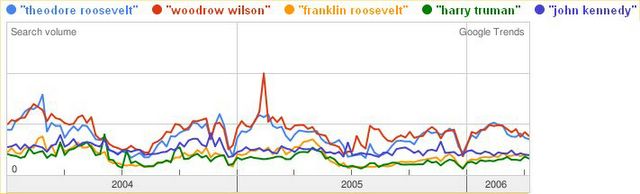
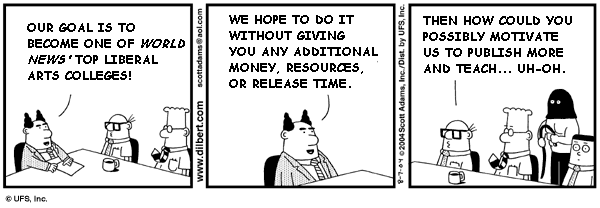
Subscribe to:
Comments (Atom)